Data Science by ODS.ai 🦜
25 May 2023 18:33
MMS: Scaling Speech Technology to 1000+ languages
Get ready for a breakthrough in speech technology that is set to revolutionize the world of communication! The field, which has so far been restricted to around a hundred languages, barely scratches the surface of the more than 7,000 languages spoken globally. The Massively Multilingual Speech (MMS) project is taking a monumental leap to bridge this gap, increasing the number of supported languages by an astounding 10 to 40 times, depending on the task. This unprecedented expansion will be a game-changer, significantly improving global access to information and creating a more inclusive digital landscape.
This incredible feat is achieved through the creation of a new dataset drawn from publicly available religious texts and the strategic implementation of self-supervised learning. The MMS project's achievements are staggering, including the development of pre-trained wav2vec 2.0 models for 1,406 languages, a single multilingual automatic speech recognition model for 1,107 languages, speech synthesis models for as many languages, and a language identification model for a whopping 4,017 languages. Even more impressive is the significant improvement in accuracy - our multilingual speech recognition model more than halves the word error rate of Whisper on 54 languages of the FLEURS benchmark, despite being trained on a significantly smaller dataset.
Paper link: https://research.facebook.com/publications/scaling-speech-technology-to-1000-languages/
Blogpost link: https://ai.facebook.com/blog/multilingual-model-speech-recognition/
Code link: https://github.com/facebookresearch/fairseq/tree/main/examples/mms
A detailed unofficial overview of the paper: https://andlukyane.com/blog/paper-review-mms
#deeplearning #speechrecognition #tts #audio
Читать полностью…
Data Science by ODS.ai 🦜
20 May 2023 23:24
Code Execution with Pre-trained Language Models
Code execution is a fundamental aspect of programming language semantics that reflects the exact behavior of the code. However, most pretrained models for code intelligence ignore the execution trace and only rely on source code and syntactic structures. In this paper, the authors aim to teach pretrained models the real-world code execution process. They propose CodeExecutor, a Transformer-based model that learns to execute arbitrary programs and predict their execution traces.
Читать полностью…
Data Science by ODS.ai 🦜
15 May 2023 09:28
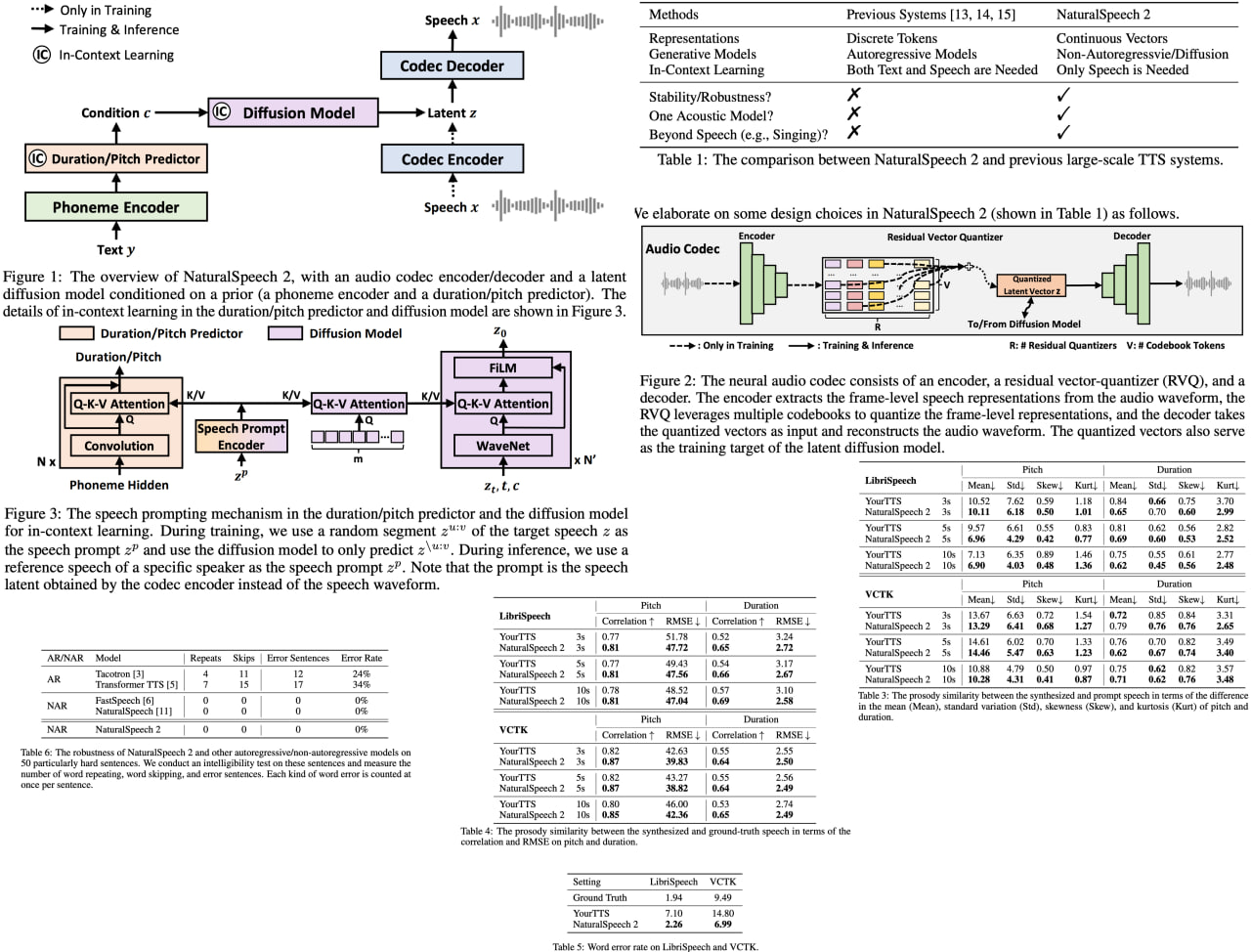
NaturalSpeech 2: Latent Diffusion Models are Natural and Zero-Shot Speech and Singing Synthesizers
In the rapidly evolving domain of text-to-speech (TTS) technology, an exciting breakthrough has been made with the development of NaturalSpeech 2. This innovative system brings new levels of diversity to the table, by uniquely capturing a wide range of human speech characteristics such as speaker identities, prosodies, and even styles like singing. By employing a neural audio codec and residual vector quantizers, it transcends the limitations of existing TTS systems, which often suffer from unstable prosody, word skipping/repeating issues, and subpar voice quality.
More impressively, NaturalSpeech 2 enhances the "zero-shot" capability, a crucial factor for diverse speech synthesis. By designing a unique speech prompting mechanism, it facilitates in-context learning in both the diffusion model and the duration/pitch predictor. Its expansive training on 44K hours of speech and singing data has yielded unprecedented results. NaturalSpeech 2 significantly outperforms previous TTS systems in prosody/timbre similarity, robustness, and voice quality, even demonstrating novel zero-shot singing synthesis.
Project link: https://speechresearch.github.io/naturalspeech2/
Paper link: https://arxiv.org/pdf/2304.09116.pdf
A detailed unofficial overview of the paper: https://andlukyane.com/blog/paper-review-naturalspeech2
#deeplearning #nlp #tts #texttospeech
Читать полностью…
Data Science by ODS.ai 🦜
12 May 2023 09:38
Launching the Open Data Science Talent Pool Initiative!
Hello, community!
We received several requests to organize some tools to match people seeking career / pet projects matching opportunities. So now we are launching the Open Data Science Talent Pool!
The field of data science is rapidly evolving, and we recognize the importance of matching skilled professionals with organizations that value their unique capabilities. This Talent Pool Initiative is our endeavor to facilitate these connections, making the opportunities search process smoother and more efficient for everyone involved.
Here's how it works:
🔍 For Opportunities Seekers:
If you're a data scientist, machine learning engineer, AI specialist, or hold any other role in the data science domain, we invite you to submit your resume and a brief introduction about yourself. This is a fantastic opportunity to showcase your skills, interests, and aspirations to potential employers. Don't forget to highlight those special projects or unique experiences that make you stand out!
🏢 For Talent Seekers:
If you're an organization or an individual looking for talented individuals in the field of data science, our Talent Pool will be an invaluable resource. You'll have access to a diverse array of professionals, each with their own unique skill sets and experiences, ready to help your organization reach new heights. Make sure you submitted your request through the form in the quoted post
🔄 The Process:
1 Submission: Individuals can submit their resumes and short introductions through a dedicated form on our website (link will be shared soon).
2 Review: Our team will review these submissions to ensure they meet the necessary standards and criteria.
3 Access: Approved profiles will be included in our Talent Pool, accessible to match with the requests within our community.
During the earliest stage we are going to match the requests personally ensuring we don’t overengineer the process. We will not hesitate to introduce necessary product adjustments once the tool meets the demand inside the community.
Remember, we're all in this journey together. Whether you're looking for your next big opportunity or seeking the perfect addition to your team, we're here to support you.
Stay tuned, stay connected, and let's continue to foster a supportive, dynamic, and prosperous data science community!
Best,
ChatGPT with the prompt from Open Data Science Channel Editorial Team
Google Form: https://forms.gle/3GH1vrt91mRtstzK8
#ds_jobs #ds_intros
Читать полностью…
Data Science by ODS.ai 🦜
11 May 2023 16:57
For those how are looking beyond Data Science or wondering to play around, here is a news on the release of the portfolio company of one of the channel editors:
TON Play: the Unity SDK + payment management for games
TON Play is a toolkit for developers based on the TON blockchain and working closely with the messaging app Telegram. They recently introduced Pay-in, Mass payout, and On-demand payout methods in TON. If you dabble with games, this might be curious to test in action.
The main features:
* projects get paid by Telegram users in TON
* option to add mass payouts in TON to games with cash prizes
* automated payouts on user demand
TON Play also released SDKs, allowing projects to manage assets and in-game marketplace and port Unity or HTML5 games to work inside Telegram as a web app. SDKs are written in Unity, Python, and Typescript.
Website: https://tonplay.io/
Documentation: https://docs.tonplay.io/
Telegram channel: /channel/tonplayinsider
Contacts: @, gamedevs@tonplay.io
#ds_jobs #ds_resumes
Читать полностью…
Data Science by ODS.ai 🦜
10 May 2023 06:11
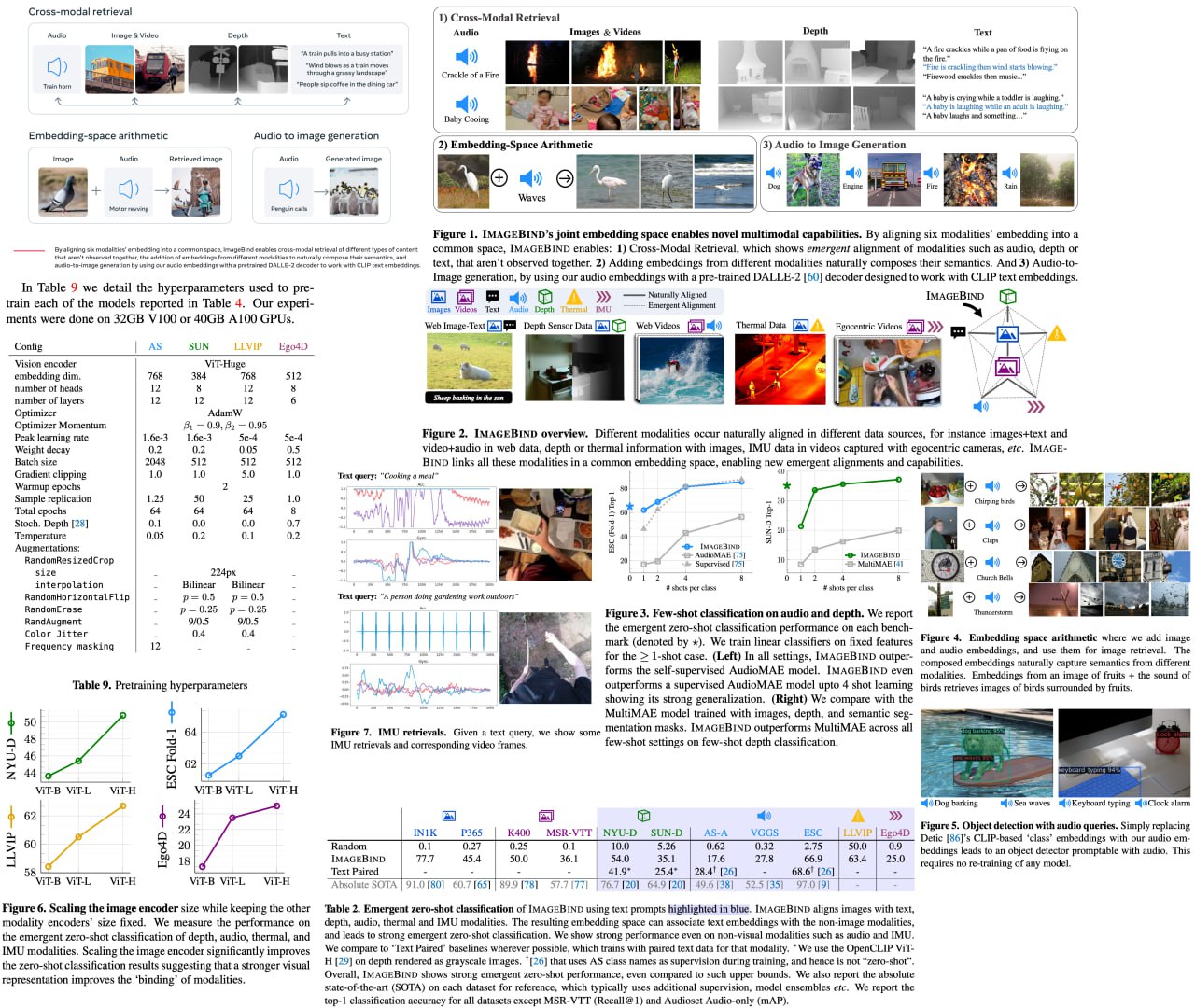
ImageBind: One Embedding Space To Bind Them All
Introducing ImageBind, a groundbreaking approach that learns a joint embedding across six different modalities – images, text, audio, depth, thermal, and IMU data – using only image-paired data. This innovative method leverages recent large-scale vision-language models, extending their zero-shot capabilities to new modalities through their natural pairing with images. ImageBind unlocks a myriad of novel emergent applications 'out-of-the-box,' including cross-modal retrieval, composing modalities with arithmetic, cross-modal detection, and generation.
ImageBind's emergent capabilities improve as the strength of the image encoder increases, setting a new state-of-the-art benchmark in emergent zero-shot recognition tasks across modalities, even outperforming specialist supervised models. Furthermore, ImageBind demonstrates impressive few-shot recognition results, surpassing prior work in the field. This pioneering technique offers a fresh way to evaluate vision models for both visual and non-visual tasks, opening the door to exciting advancements in AI and machine learning.
Blogpost link: https://ai.facebook.com/blog/imagebind-six-modalities-binding-ai/
Code link: https://github.com/facebookresearch/ImageBind
Paper link: https://dl.fbaipublicfiles.com/imagebind/imagebind_final.pdf
Demo link: https://imagebind.metademolab.com/
A detailed unofficial overview of the paper: https://andlukyane.com/blog/paper-review-imagebind
#deeplearning #nlp #multimodal #cv #embedding
Читать полностью…
Data Science by ODS.ai 🦜
09 January 2018 14:34
Unfortunately, discrimination against ML competition participants becomes more frequent. CrowdANALYTIX recently launched a competition that simply bans different countries from opportunity to participate, this time including Russia.
Spread the word so that we could make Data Science and ML more open, without obsolete discriminatory rules on competition platforms:
https://www.facebook.com/DataChallenges/photos/a.136318350296824.1073741827.136313013630691/182693245659334/?type=3&theater
Читать полностью…
Data Science by ODS.ai 🦜
05 December 2017 12:14
High-Resolution Image Synthesis and Semantic Manipulation with Conditional GANs.
Now mankind can generate content for social networks without taking photoes.
Github: https://github.com/NVIDIA/pix2pixHD
Arxiv: https://arxiv.org/pdf/1711.11585.pdf
Читать полностью…
Data Science by ODS.ai 🦜
03 December 2017 13:32
AI index report, demonstrating hype around AI techonologies: https://aiindex.org/2017-report.pdf
Читать полностью…
Data Science by ODS.ai 🦜
28 November 2017 17:45
#DeepLearning predicts when patients die with Average Precision 0.69 (that’s high).
Andrew Ng announced new project in his twitter: ML to help prioritize palliative (end-of-life) care. Model uses an 18-layer Deep Neural Network that inputs the EHR data of a patient, and outputs the probability of death in the next 3-12 months.
The trained model achieves an AUROC score of 0.93 and an Average Precision score of 0.69 on cross validation.
Site: https://stanfordmlgroup.github.io/projects/improving-palliative-care/
Arxiv: https://arxiv.org/abs/1711.06402
#project #DSinthewild #casestudy
Читать полностью…
Data Science by ODS.ai 🦜
27 November 2017 12:21
StarGAN — a novel and scalable approach that can perform image-to-image translations for multiple domains using only a single model.
GitHub: https://github.com/yunjey/StarGAN
Arxiv: https://arxiv.org/abs/1711.09020
#deeplearning #gan #cv
Читать полностью…
Data Science by ODS.ai 🦜
23 November 2017 12:00
An article about #BigBrother. How Facebook is able to track users interests based on 3 likes.
Enhancing Transparency and Control When Drawing Data-Driven Inferences About Individuals
http://online.liebertpub.com/doi/full/10.1089/big.2017.0074
Читать полностью…
Data Science by ODS.ai 🦜
16 November 2017 11:07
#CapsNet #architecture
Читать полностью…
Data Science by ODS.ai 🦜
22 May 2023 06:31
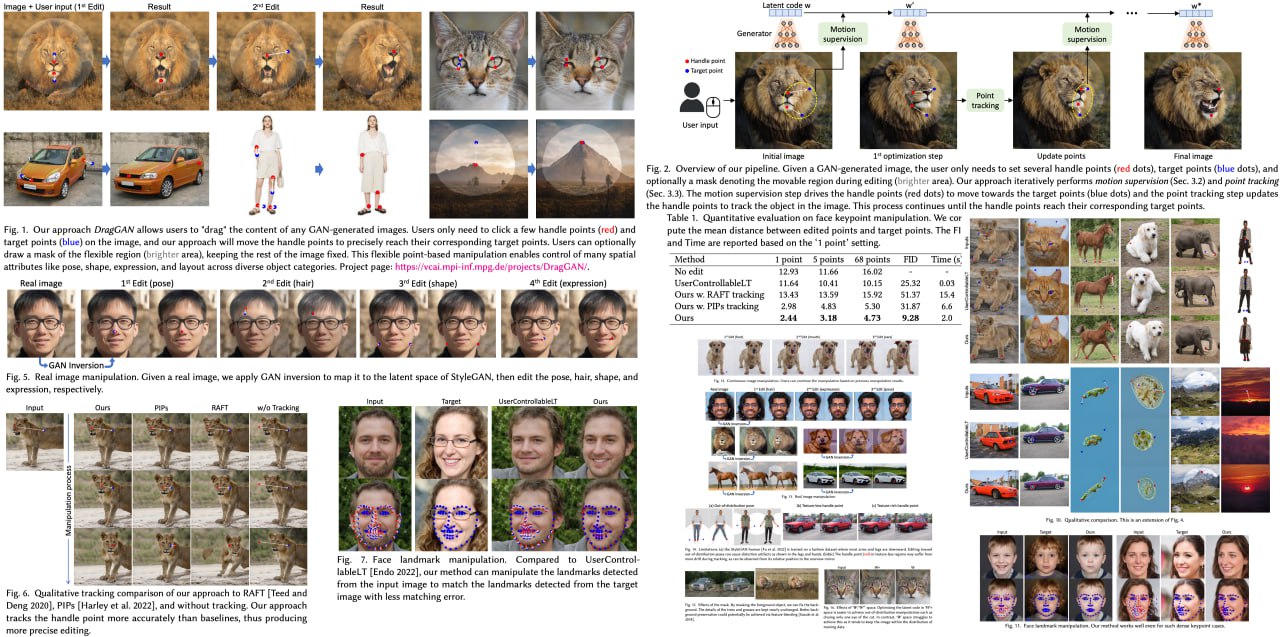
Drag Your GAN: Interactive Point-based Manipulation on the Generative Image Manifold
Meet DragGAN, a groundbreaking approach that is set to revolutionize the way we control generative adversarial networks (GANs) and synthesize visual content! This innovative tool offers users unprecedented flexibility and precision when manipulating images, sidestepping the limitations of prior 3D models and annotated training data. With DragGAN, you can now "drag" any point of an image to a precise target position, introducing a nvel user-interactive element.
Two ingenious components underpin DragGAN's functionality: the first is a feature-based motion supervision that effortlessly guides the handle point towards the desired position, and the second is a novel point tracking approach that utilizes the discriminating features of the generator to maintain the handle points' positions. The real game-changer is that anyone can now deform an image with absolute control over pixel movements, enabling the manipulation of pose, shape, expression, and layout across diverse categories like animals, cars, humans, landscapes, and more. DragGAN outperforms its predecessors in both image manipulation and point tracking tasks, promising an exciting leap forward in AI-generated visual content!
Paper link: https://arxiv.org/abs/2305.10973
Code link: https://github.com/XingangPan/DragGAN
Project link: https://vcai.mpi-inf.mpg.de/projects/DragGAN/
A detailed unofficial overview of the paper: https://andlukyane.com/blog/paper-review-draggan
#deeplearning #cv #gan #imagemanipulation
Читать полностью…
Data Science by ODS.ai 🦜
18 May 2023 06:47
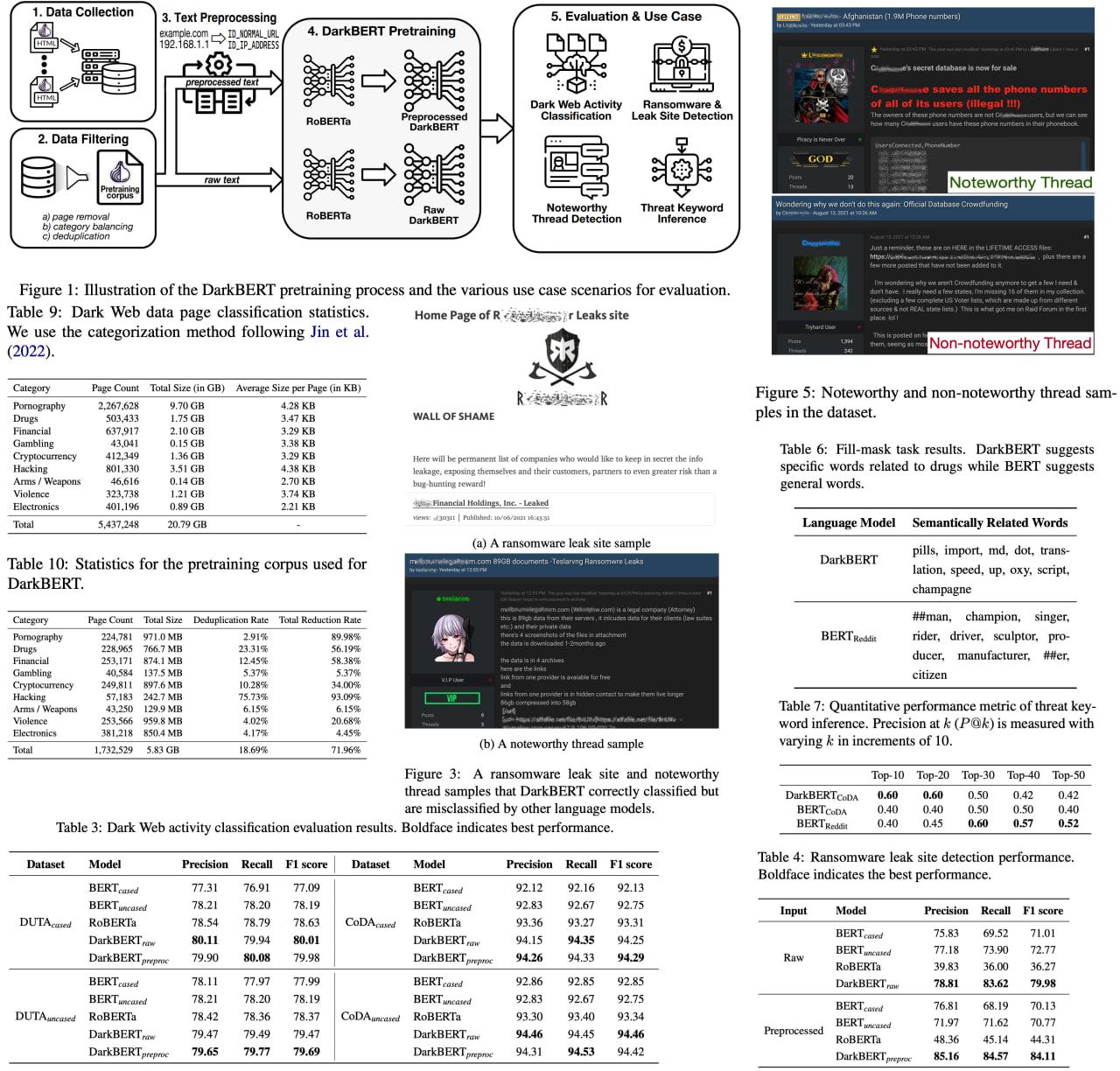
DarkBERT: A Language Model for the Dark Side of the Internet
The researchers have developed a novel model called DarkBERT, which specifically focuses on the linguistically complex and often misunderstood domain of the Dark Web. This innovative model stands out due to its unique pretraining on Dark Web data, which allows it to handle the extreme lexical and structural diversity characteristic of the Dark Web. This is a critical development considering the clear differences that exist in language use between the Dark Web and the Surface Web, a factor that can often hinder accurate textual analysis.
DarkBERT isn't just a novelty, but a robust, high-performing language model that consistently outshines current popular models like BERT and RoBERTa in various use cases. These findings shed light on the considerable advantages that a domain-specific model like DarkBERT can offer. More than anything else, DarkBERT promises to be a vital resource for future research on the Dark Web, setting a new standard for language models in this intriguing and intricate realm.
Paper link: https://arxiv.org/abs/2305.08596
A detailed unofficial overview of the paper: https://andlukyane.com/blog/paper-review-darkbert
#deeplearning #nlp #darkweb #cybersecurity
Читать полностью…
Data Science by ODS.ai 🦜
12 May 2023 23:59
Introducing 100K Token Context Windows
- approximately 75K words
- hundreds of pages
- a book, for example "The Great Gatsby" (about 72K tokens)
- a text that will take approximately 5 hours to read
Читать полностью…
Data Science by ODS.ai 🦜
11 May 2023 19:44
StarCoder: may the source be with you!
The BigCode community, an open-scientific collaboration working on the responsible development of Code LLMs, introduces StarCoder and StarCoderBase:
- 15.5B parameter models
- 8K context length
- StarCoderBase is trained on 1 trillion tokens sourced from The Stack, a large collection of permissively licensed GitHub repositories with inspection tools and an opt-out process
- StarCoderBase is fine-tuned on 35B Python tokens, resulting in the creation of StarCoder
StarCoderBase outperforms every open Code LLM that supports multiple programming languages and matches or outperforms the OpenAI code-cushman-001 model.
Читать полностью…
Data Science by ODS.ai 🦜
10 May 2023 14:53
Found another PyTorch-based library with basic image functions, losses and transformations
Looks like it is a combination toolkit of augs, skimage and classic cv2 functions, but written in PyTorch.
What is Kornia? Kornia is a differentiable library that allows classical computer vision to be integrated into deep learning models.
Examples:
- https://kornia.readthedocs.io/en/latest/get-started/highlights.html
- and especially this https://kornia.readthedocs.io/en/latest/losses.html
Читать полностью…
Data Science by ODS.ai 🦜
22 March 2018 08:55
Nature has published an article with a #superresolution approach for #CT scans.
https://www.sciencedaily.com/releases/2018/03/180321155324.htm
#arxiv: https://arxiv.org/abs/1704.08841
Читать полностью…
Data Science by ODS.ai 🦜
13 January 2018 18:00
Graph shows what people really mean when they use vague terminology describing the probability of an event.
Читать полностью…
Data Science by ODS.ai 🦜
23 December 2017 00:00
Another paper on automl: Neural Nets learning to design Neural Nets.
A reinforcement learning agent that learns to program new neural network architectures.
Same/better results as LSTMs but with funky nonlinearities (sine, SeLus, etc) and new connections that result in different activation patterns.
Arxiv: https://arxiv.org/abs/1712.07316
Post: https://einstein.ai/research/domain-specific-language-for-automated-rnn-architecture-search
Читать полностью…
Data Science by ODS.ai 🦜
05 December 2017 12:13
pix2pix Demo: Neural network generates cityscape based on the input label map.
Читать полностью…
Data Science by ODS.ai 🦜
30 November 2017 15:22
Video displaying progress of GANs for photo generation. Now you can use neural networks to generate HD photo of a person who never existed.
https://www.youtube.com/watch?v=XOxxPcy5Gr4
#GAN #youtube
Читать полностью…
Data Science by ODS.ai 🦜
28 November 2017 13:50
An article about the impossibility of intelligence explosion. There will be no singularity or significant breakthrough and humanity will die off becuase of sun explosion.
francois.chollet/the-impossibility-of-intelligence-explosion-5be4a9eda6ec" rel="nofollow">https://medium.com/@.chollet/the-impossibility-of-intelligence-explosion-5be4a9eda6ec
Читать полностью…
Data Science by ODS.ai 🦜
27 November 2017 12:20
Astonishing results on emotion generation and image altering with StarGAN
Читать полностью…
Data Science by ODS.ai 🦜
24 November 2017 19:33
#CapsNet #tutorial on the YouTube
https://www.youtube.com/watch?v=pPN8d0E3900
#deeplearning
Читать полностью…
Data Science by ODS.ai 🦜
16 November 2017 11:08
And another posts on #CapsNet and how they work.
Capsule Networks Are Shaking up AI — Here’s How to Use Them: https://hackernoon.com/capsule-networks-are-shaking-up-ai-heres-how-to-use-them-c233a0971952
Understanding Hinton’s Capsule Networks. Part I: Intuition:
pechyonkin/understanding-hintons-capsule-networks-part-i-intuition-b4b559d1159b" rel="nofollow">https://medium.com/@sule-networks-part-i-intuition-b4b559d1159b
Understanding Hinton’s Capsule Networks. Part II: How Capsules Work:
pechyonkin/understanding-hintons-capsule-networks-part-ii-how-capsules-work-153b6ade9f66" rel="nofollow">https://medium.com/@sule-networks-part-ii-how-capsules-work-153b6ade9f66
Читать полностью…
Data Science by ODS.ai 🦜
16 November 2017 11:07
On 1st of November Geoff Hinton — one of the top NN researches has published two papers introducing new approach for #CV problems: Capsule Networks.
These architecture allows to recognize a face on the picture by detecting eyes, nose, mouth, regardless of the position / scaling / rotating the elements.
In other words, these approach allows neural network to be invariant to transformation of object.
First of papers: https://arxiv.org/abs/1710.09829
Second paper: https://openreview.net/forum?id=HJWLfGWRb&noteId=HJWLfGWRb
Article on Wired: https://www.wired.com/story/googles-ai-wizard-unveils-a-new-twist-on-neural-networks/
Explanation on hackernoon: https://hackernoon.com/what-is-a-capsnet-or-capsule-network-2bfbe48769cc
Another post with explanation: https://kndrck.co/posts/capsule_networks_explained/
Читать полностью…


 46227
46227