Astronomy Picture of the Day
30 September 2021 06:23
The Hydrogen Clouds of M33
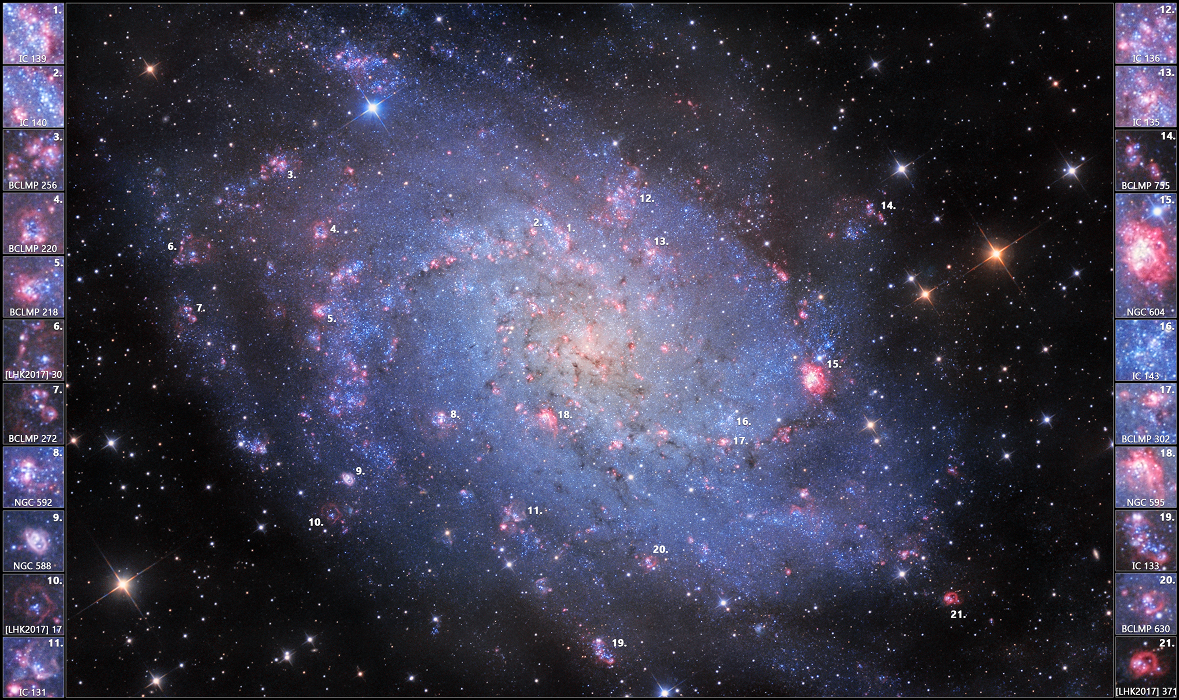
Gorgeous spiral galaxy M33 seems to have more than its fair share of glowing hydrogen gas. A prominent member of the local group of galaxies, M33 is also known as the Triangulum Galaxy and lies a mere 3 million light-years away. Sprawling along loose spiral arms that wind toward the core, M33's giant HII regions are some of the largest known stellar nurseries, sites of the formation of short-lived but very massive stars. Intense ultraviolet radiation from the luminous massive stars ionizes the surrounding hydrogen gas and ultimately produces the characteristic red glow. To highlight the HII regions in this telescopic image, broadband data used to produce a color view of the galaxy were combined with narrowband data recorded through a hydrogen-alpha filter, transmitting the light of the strongest hydrogen emission line. Close-ups of cataloged HII regions appear in the sidebar insets. Use the individual reference number to find their location within the Triangulum Galaxy. For example, giant HII region NGC604 is identified in an inset on the right and appears at position number 15. That's about 4 o'clock from galaxy center in this portrait of M33.
Читать полностью…
Astronomy Picture of the Day
28 September 2021 06:23
Night of the Perseids
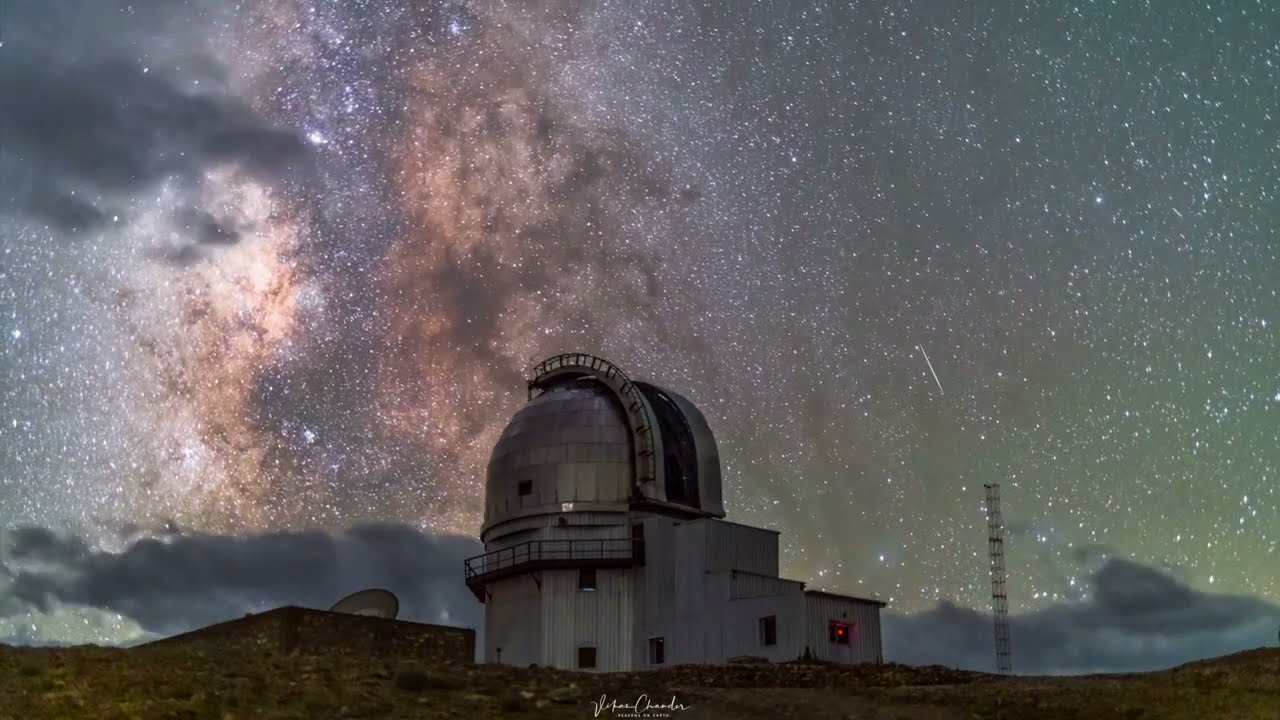
Have you ever experienced a meteor shower? To help capture the wonder, a video was taken during the peak of the recent Perseid meteor shower above the Indian Astronomical Observatory in Hanle, India, high up in the Himalayan mountains. Night descends as the video begins, with the central plane of our Milky Way Galaxy approaching from the left and Earth-orbiting satellites zipping by overhead. During the night, the flash of meteors that usually takes less than a second is artificially extended. The green glow of most meteors is typically caused by vaporizing nickel. As the video continues, Orion rises and meteors flare above the 2-meter Himalayan Chandra Telescope and the seven barrels of the High Energy Gamma Ray Telescope (Hagar). The 2 minute 30 second movie ends with the Sun rising, preceded by a false dawn of zodiacal light.
Читать полностью…
Astronomy Picture of the Day
26 September 2021 06:23
The Red Square Nebula
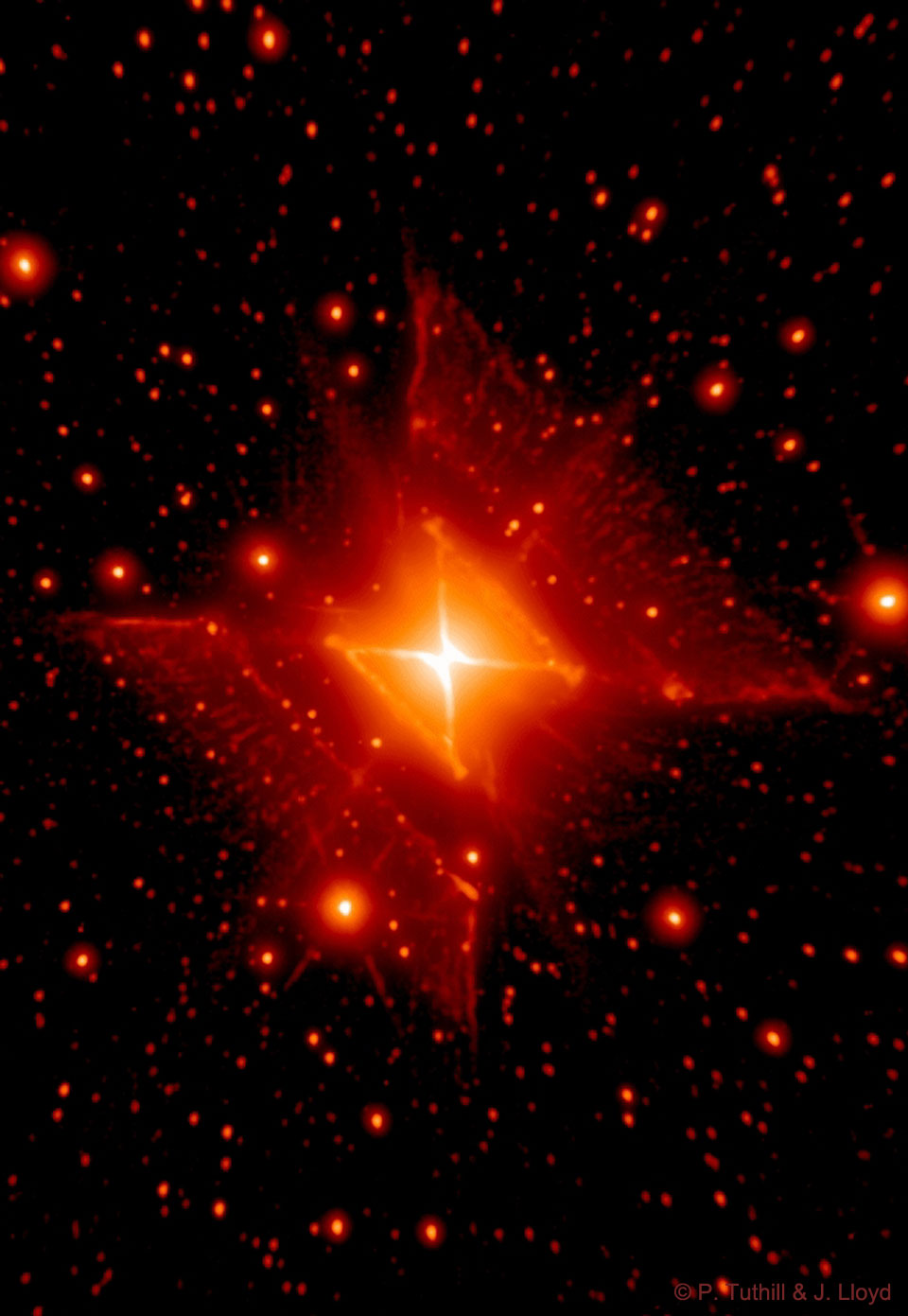
How did a round star create this square nebula? No one is quite sure. The round star, known as MWC 922 and possibly part of a multiple star system, appears at the center of the Red Square Nebula. The featured image combines infrared exposures from the Hale Telescope on Mt. Palomar in California, and the Keck-2 Telescope on Mauna Kea in Hawaii. A leading progenitor hypothesis for the square nebula is that the central star or stars somehow expelled cones of gas during a late developmental stage. For MWC 922, these cones happen to incorporate nearly right angles and be visible from the sides. Supporting evidence for the cone hypothesis includes radial spokes in the image that might run along the cone walls. Researchers speculate that the cones viewed from another angle would appear similar to the gigantic rings of supernova 1987A, possibly indicating that a star in MWC 922 might one day itself explode in a similar supernova.
Читать полностью…
Astronomy Picture of the Day
24 September 2021 06:23
Perseid Outburst at Westmeath Lookout
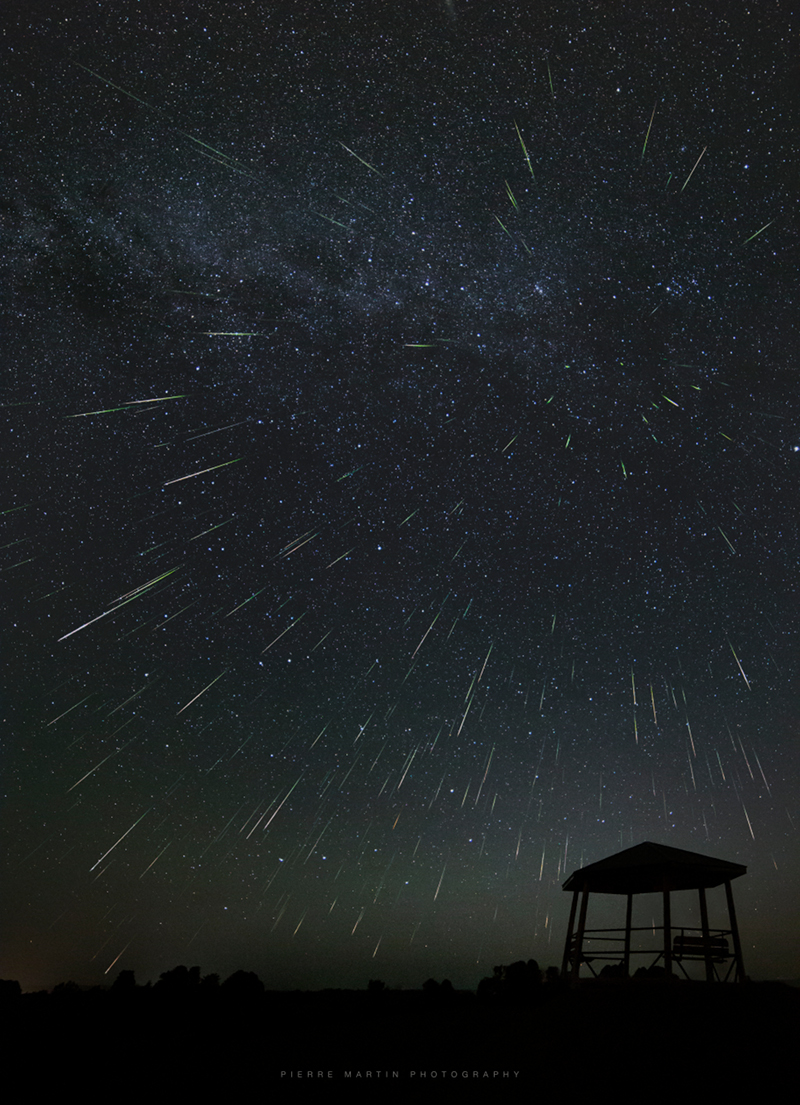
This year an outburst of Perseid meteors surprised skywatchers. The reliable meteor shower's peak was predicted for the night of August 12/13. But persistent visual observers in North America were deluged with a startling Perseid shower outburst a day later, with reports of multiple meteors per minute and sometimes per second in the early hours of August 14. The shower radiant is high in a dark night sky in this composite image. It painstakingly registers the trails of 282 Perseids captured during the stunning outburst activity between 0650 UT (02:50am EDT) and 0900 UT (05:00am EDT) on August 14 from Westmeath Lookout, Ontario. Of course the annual Perseid meteor shower is associated with planet Earth's passage through dusty debris from periodic comet 109P/Swift-Tuttle. The 2021 outburst could have been caused by an unanticipated encounter with the Perseid Filament, a denser ribbon of dust inside the broader debris zone.
Читать полностью…
Astronomy Picture of the Day
22 September 2021 06:23
Equinox on a Spinning Earth
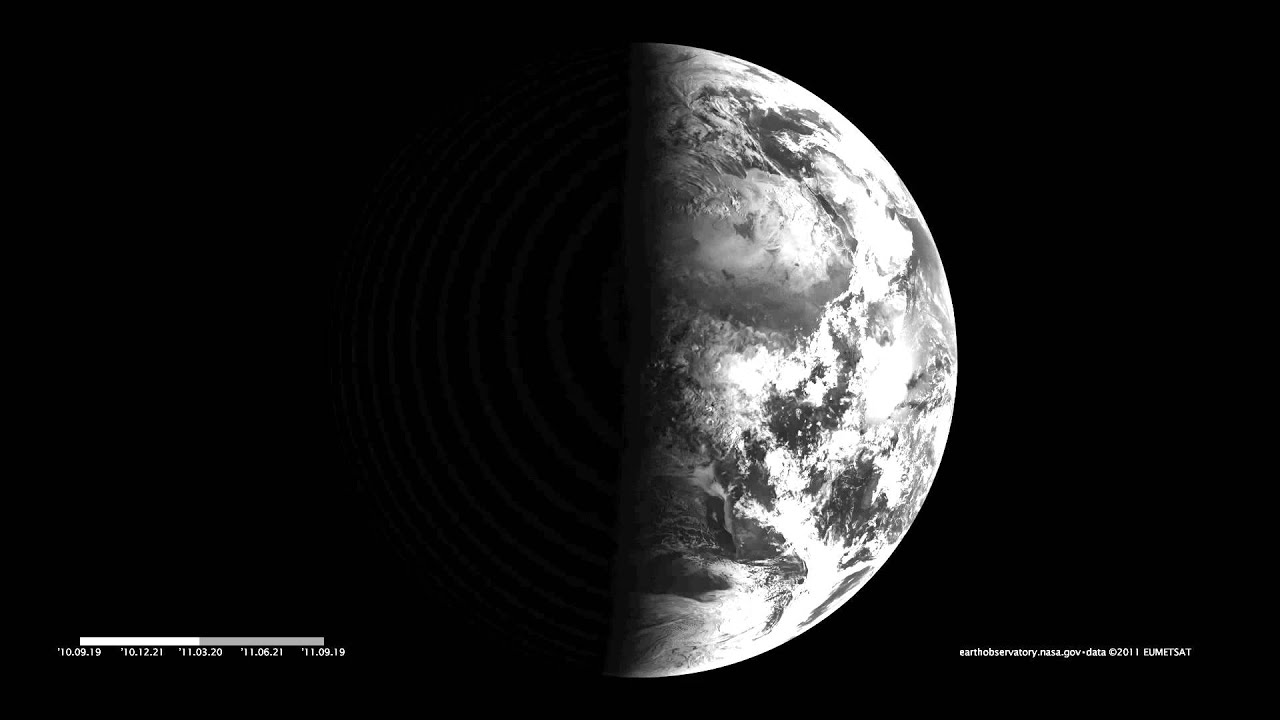
When does the line between night and day become vertical? Today. Today is an equinox on planet Earth, a time of year when day and night are most nearly equal. At an equinox, the Earth's terminator -- the dividing line between day and night -- becomes vertical and connects the north and south poles. The featured time-lapse video demonstrates this by displaying an entire year on planet Earth in twelve seconds. From geosynchronous orbit, the Meteosat 9 satellite recorded these infrared images of the Earth every day at the same local time. The video started at the September 2010 equinox with the terminator line being vertical. As the Earth revolved around the Sun, the terminator was seen to tilt in a way that provides less daily sunlight to the northern hemisphere, causing winter in the north. As the year progressed, the March 2011 equinox arrived halfway through the video, followed by the terminator tilting the other way, causing winter in the southern hemisphere -- and summer in the north. The captured year ends again with the September equinox, concluding another of billions of trips the Earth has taken -- and will take -- around the Sun.
Читать полностью…
Astronomy Picture of the Day
20 September 2021 06:23
Lynds Dark Nebula
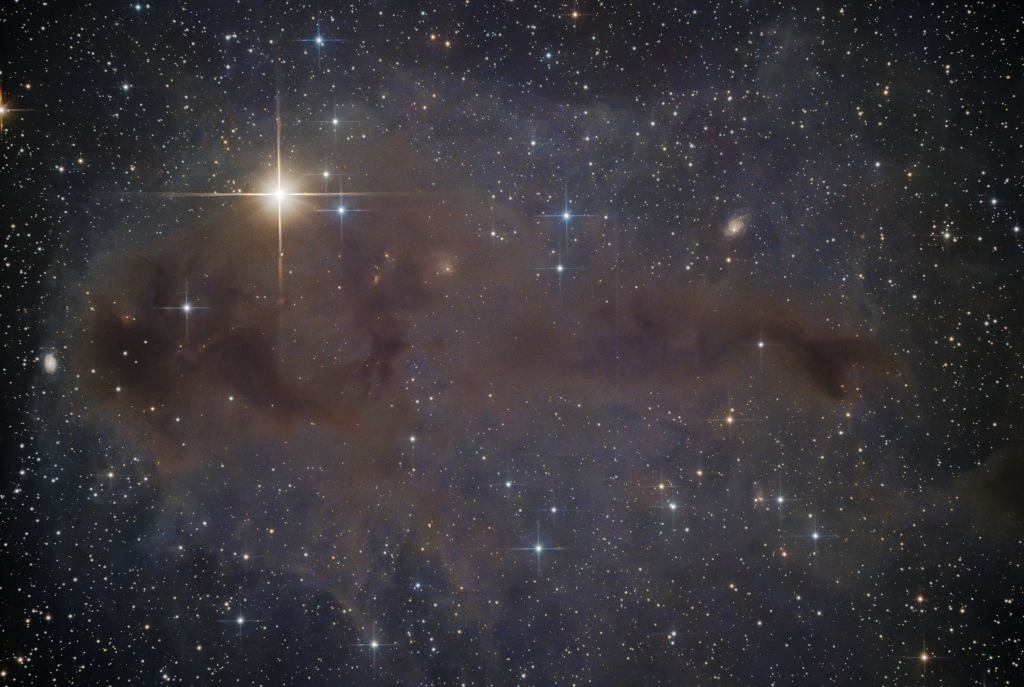
Stars are forming in Lynds Dark Nebula (LDN) 1251. About 1,000 light-years away and drifting above the plane of our Milky Way galaxy, the dusty molecular cloud is part of a complex of dark nebulae mapped toward the Cepheus flare region. Across the spectrum, astronomical explorations of the obscuring interstellar clouds reveal energetic shocks and outflows associated with newborn stars, including the telltale reddish glow from scattered Herbig-Haro objects hiding in the image. Distant background galaxies also lurk on the scene, almost buried behind the dusty expanse. This alluring view spans over two full moons on the sky, or 17 light-years at the estimated distance of LDN 1251.
Читать полностью…
Astronomy Picture of the Day
18 September 2021 06:23
Rubin's Galaxy
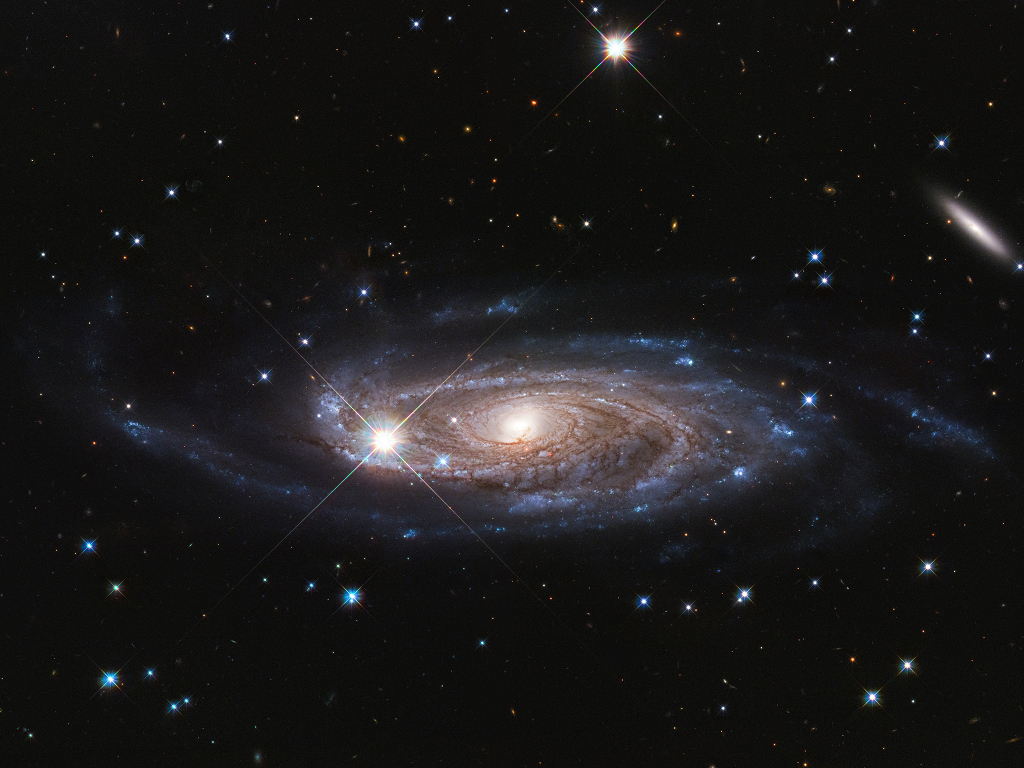
In this Hubble Space Telescope image the bright, spiky stars lie in the foreground toward the heroic northern constellation Perseus and well within our own Milky Way galaxy. In sharp focus beyond is UGC 2885, a giant spiral galaxy about 232 million light-years distant. Some 800,000 light-years across compared to the Milky Way's diameter of 100,000 light-years or so, it has around 1 trillion stars. That's about 10 times as many stars as the Milky Way. Part of an investigation to understand how galaxies can grow to such enormous sizes, UGC 2885 was also part of An Interesting Voyage and astronomer Vera Rubin's pioneering study of the rotation of spiral galaxies. Her work was the first to convincingly demonstrate the dominating presence of dark matter in our universe.
Читать полностью…
Astronomy Picture of the Day
16 September 2021 06:23
North America and the Pelican
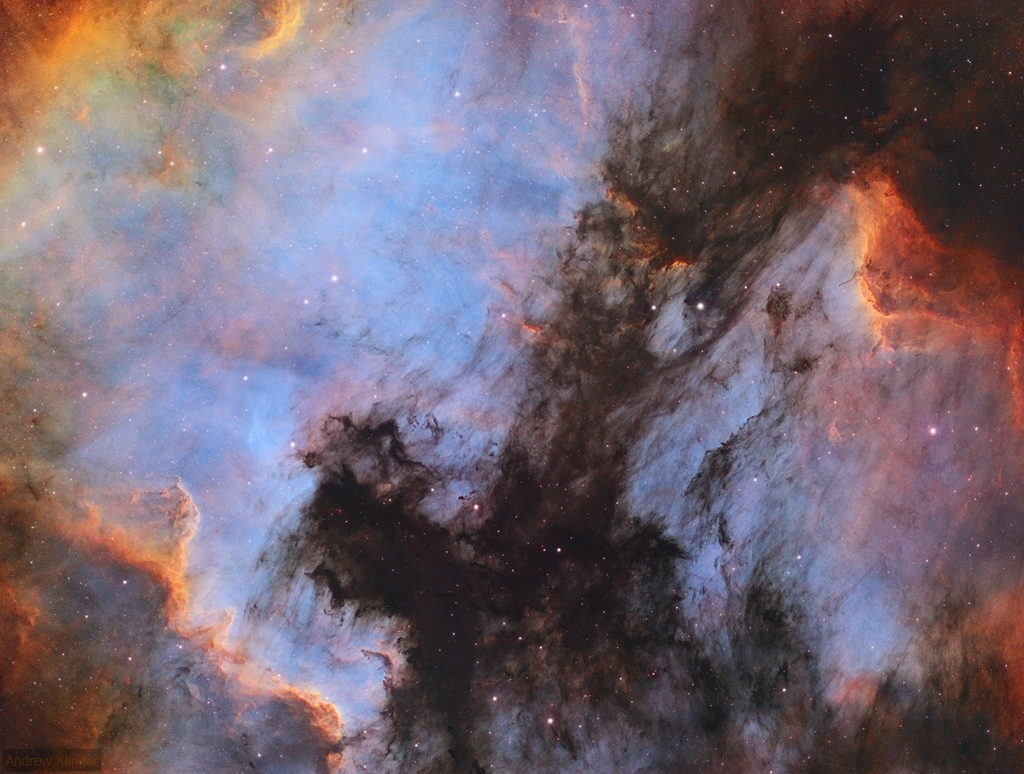
Fans of our fair planet might recognize the outlines of these cosmic clouds. On the left, bright emission outlined by dark, obscuring dust lanes seems to trace a continental shape, lending the popular name North America Nebula to the emission region cataloged as NGC 7000. To the right, just off the North America Nebula's east coast, is IC 5070, whose avian profile suggests the Pelican Nebula. The two bright nebulae are about 1,500 light-years away, part of the same large and complex star forming region, almost as nearby as the better-known Orion Nebula. At that distance, the 3 degree wide field of view would span 80 light-years. This careful cosmic portrait uses narrow band images combined to highlight the bright ionization fronts and the characteristic glow from atomic hydrogen, sulfur, and oxygen gas. These nebulae can be seen with binoculars from a dark location. Look northeast of bright star Deneb in the constellation Cygnus the Swan.
Читать полностью…
Astronomy Picture of the Day
14 September 2021 06:23
Mars Panorama 360 from Curiosity
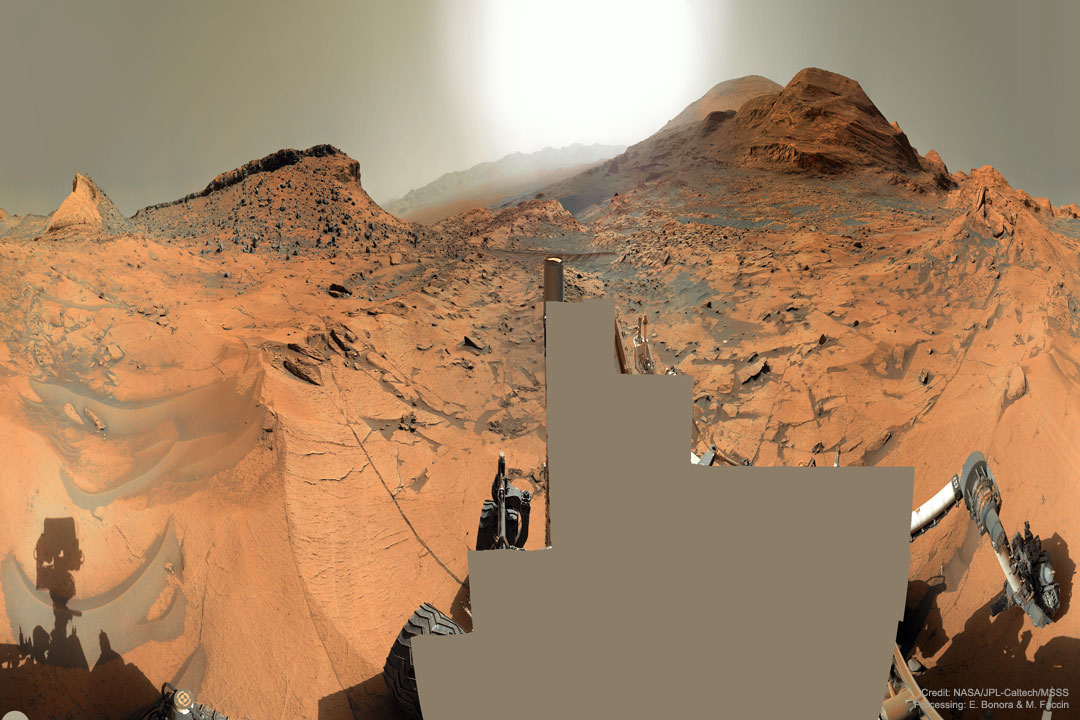
Which way up Mount Sharp? In early September, the robotic rover Curiosity continued its ascent up the central peak of Gale Crater, searching for more clues about ancient water and further evidence that Mars could once have been capable of supporting life. On this recent Martian morning, before exploratory drilling, the rolling rover took this 360-degree panorama, in part to help Curiosity's human team back on Earth access the landscape and chart possible future routes. In the horizontally-compressed featured image, an amazing vista across Mars was captured, complete with layered hills, red rocky ground, gray drifting sand, and a dusty atmosphere. The hill just left of center has been dubbed Maria Gordon Notch in honor of a famous Scottish geologist. The current plan is to direct Curiosity to approach, study, and pass just to the right of Gordon Notch on its exploratory trek.
Читать полностью…
Astronomy Picture of the Day
12 September 2021 06:23
A Spiral Aurora over Iceland
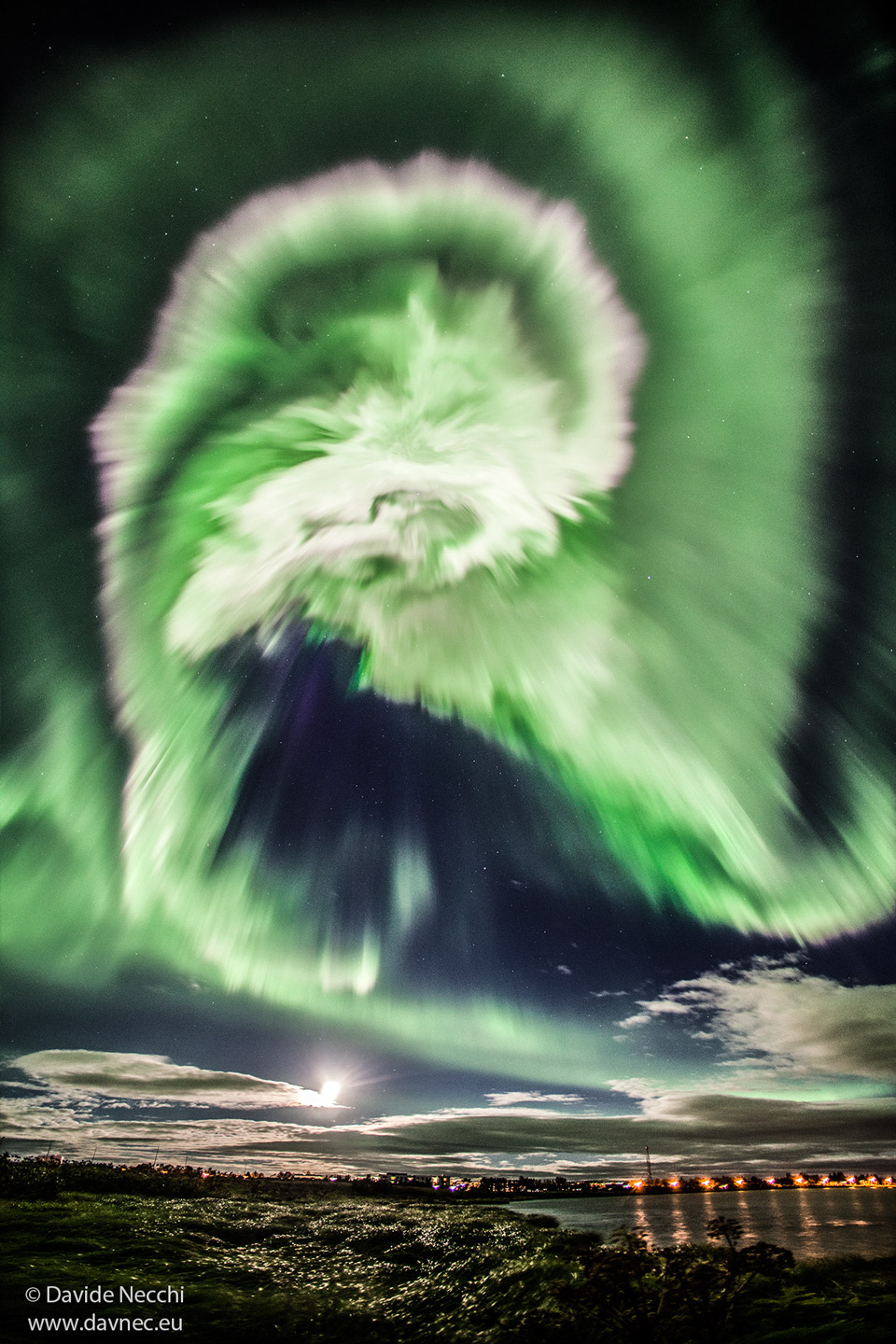
What's happened to the sky? Aurora! Captured in 2015, this aurora was noted by Icelanders for its great brightness and quick development. The aurora resulted from a solar storm, with high energy particles bursting out from the Sun and through a crack in Earth's protective magnetosphere a few days later. Although a spiral pattern can be discerned, creative humans might imagine the complex glow as an atmospheric apparition of any number of common icons. In the foreground of the featured image is the Ölfusá River while the lights illuminate a bridge in Selfoss City. Just beyond the low clouds is a nearly full Moon. The liveliness of the Sun -- and likely the resulting auroras on Earth -- is slowly increasing as the Sun emerges from a Solar minimum, a historically quiet period in its 11-year cycle.
Читать полностью…
Astronomy Picture of the Day
10 September 2021 06:23
Rosetta's Comet in View
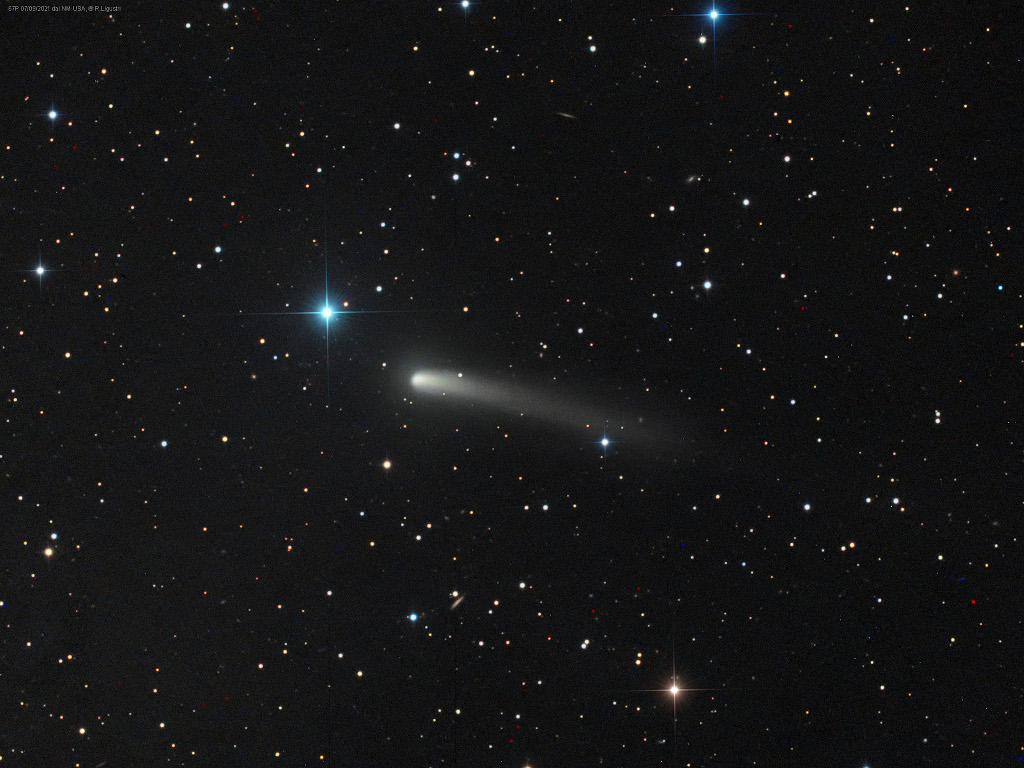
Faint comet Churyumov-Gerasimenko (67P) sweeps past background stars in the constellation Taurus and even fainter distant galaxies in this telescopic frame from September 7. About 5 years ago, this comet's 4 kilometer spanning, double-lobed nucleus became the final resting place of robots from planet Earth, following the completion of the historic Rosetta mission to the comet. After wandering out beyond the orbit of Jupiter, Churyumov-Gerasimenko is now returning along its 6.4 year periodic orbit toward its next perihelion or closest approach to the Sun, on November 2. On November 12, the comet's perigee, its closest approach to Earth, will bring it within about 0.42 astronomical units. Telescopes should still be required to view it even at its brightest, predicted to be in late November and December. On September 7 Rosetta's comet was about 0.65 astronomical units away or about 5.4 light-minutes from our fair planet.
Читать полностью…
Astronomy Picture of the Day
08 September 2021 06:23
The Deep Sky Toward Andromeda
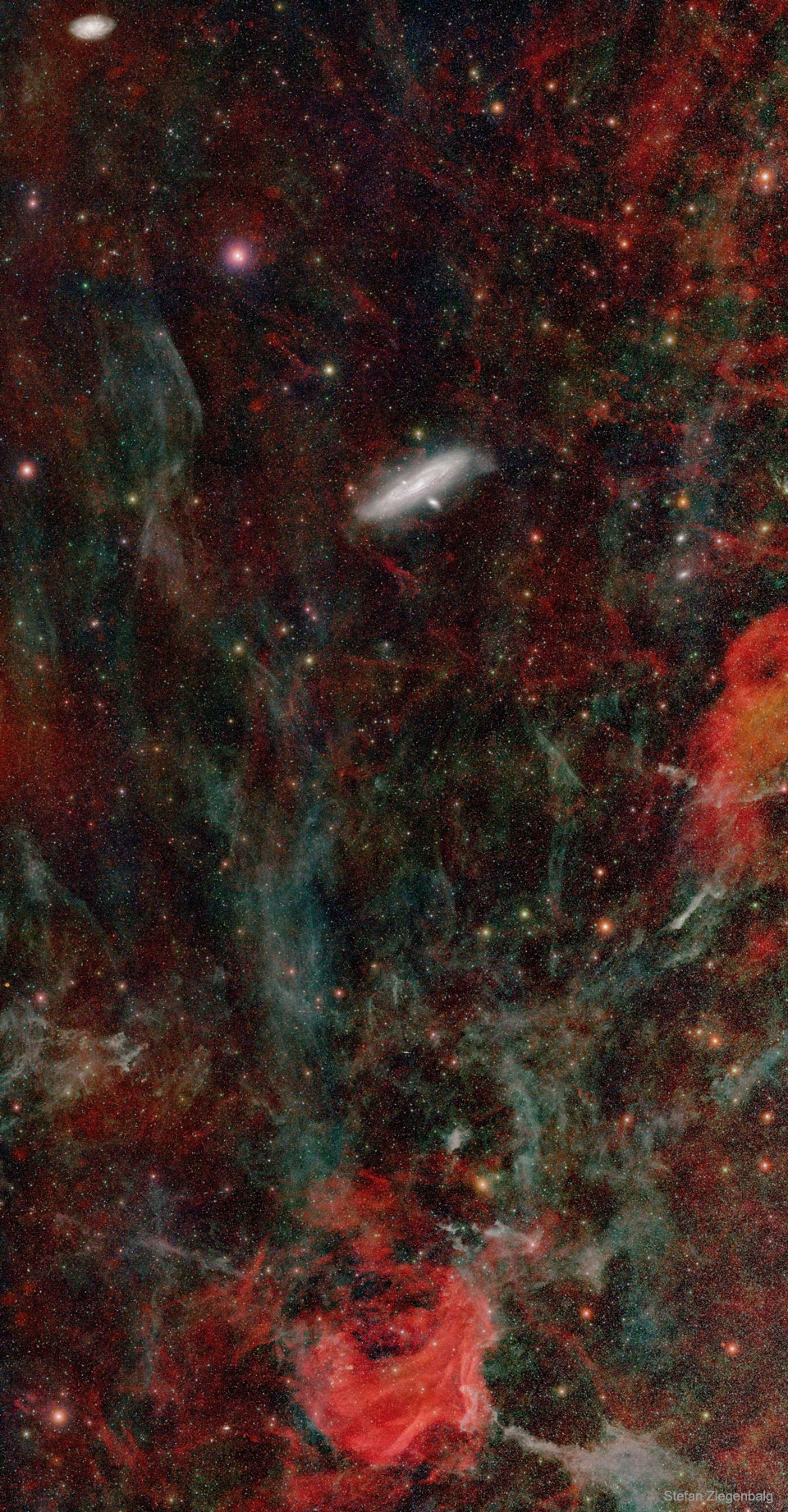
What surrounds the Andromeda galaxy? Out in space, Andromeda (M31) is closely surrounded by several small satellite galaxies, and further out it is part of the Local Group of Galaxies -- of which our Milky Way galaxy is also a member. On the sky, however, gas clouds local to our Milky Way appear to surround M31 -- not unlike how water clouds in Earth's atmosphere may appear to encompass our Moon. The gas clouds toward Andromeda, however, are usually too faint to see. Enter the featured 45-degree long image -- one of the deeper images yet taken of the broader Andromeda region. This image, sensitive to light specifically emitted by hydrogen gas, shows these faint and unfamiliar clouds in tremendous detail. But the image captures more. At the image top is the Triangulum galaxy (M33), the third largest galaxy in the Local Group and the furthest object that can be seen with the unaided eye. Below M33 is the bright Milky-Way star Mirach. The image is the digital accumulation of several long exposures taken from 2018 to 2021 from Pulsnitz, Germany.
Читать полностью…
Astronomy Picture of the Day
06 September 2021 06:23
Firefly Milky Way over Russia
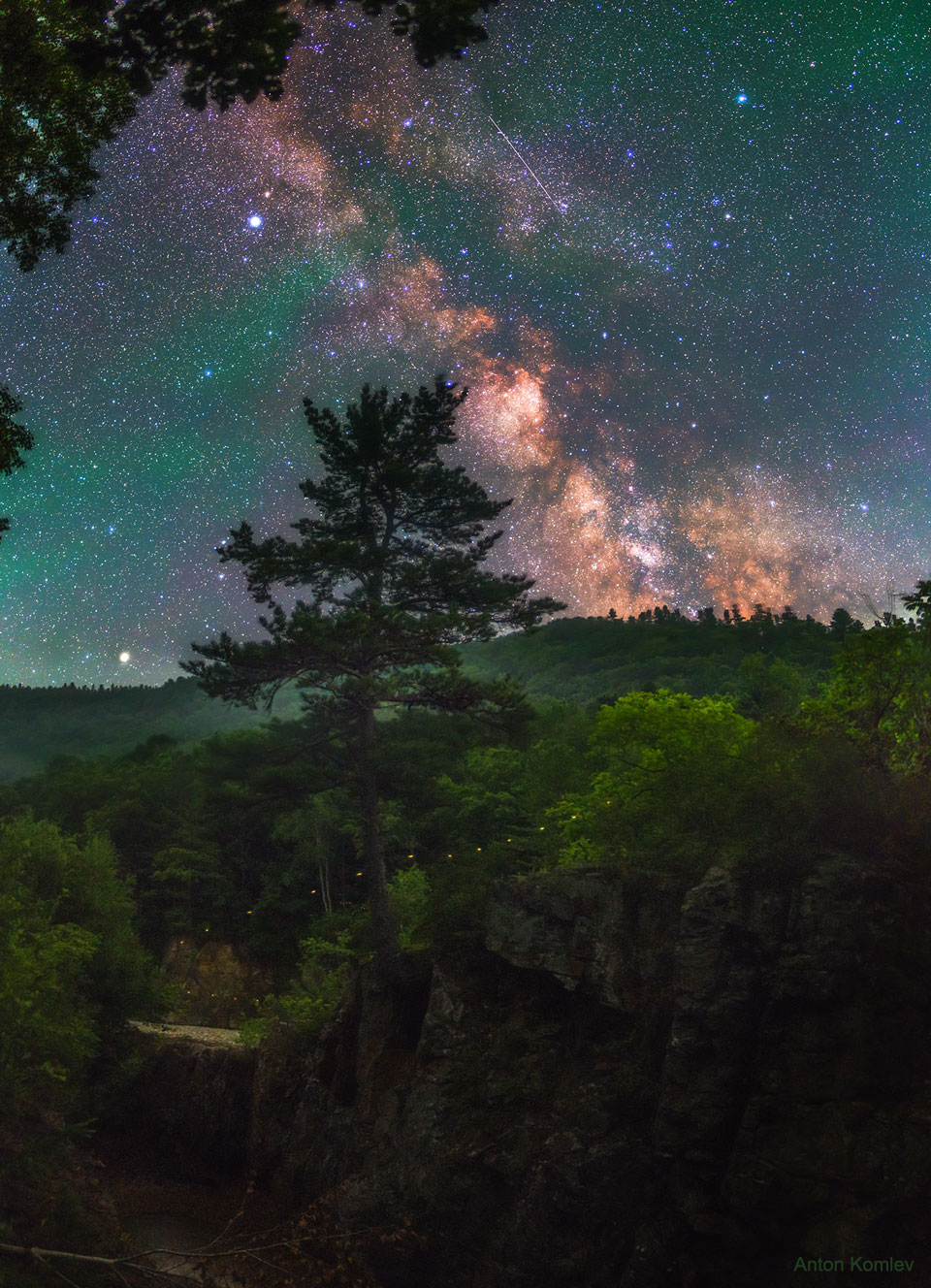
It started with a pine tree. The idea was to photograph a statuesque pine in front of the central band of our Milky Way Galaxy. And the plan, carried out two months ago, was successful -- they both appear prominently. But the resulting 3-frame panorama captured much more. Colorful stars, for example, dot the distant background, with bright Altair visible on the upper left. The planet Saturn, a bit closer, was captured just over the horizon on the far left. Just beyond the Earth's atmosphere, seen in the upper right, an Earth-orbiting satellite was caught leaving a streak during the 25-second exposure. The Earth's atmosphere itself was surprisingly visible -- as green airglow across the image top. Finally, just by chance, there was a firefly. Do you see it? Near the image bottom, the firefly blinked in yellow several times as it fluttered before the rolling hills above Milogradovka River in Primorsky Krai, Russia.
Читать полностью…
Astronomy Picture of the Day
04 September 2021 06:23
A Falcon 9 Nebula
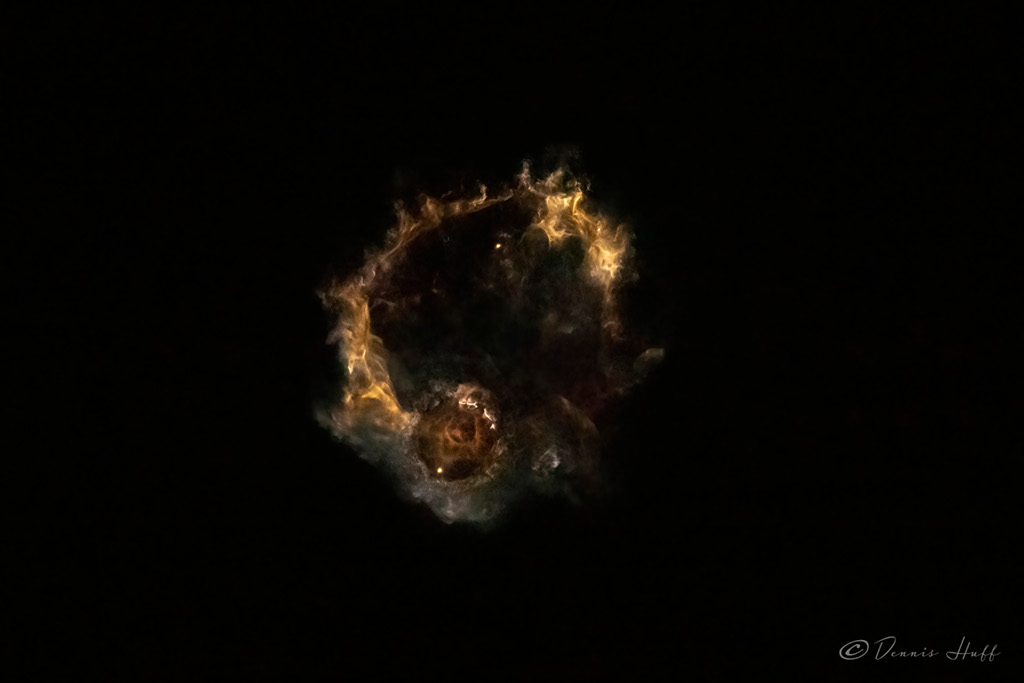
Not the Hubble Space Telescope's latest view of a distant galactic nebula, this illuminated cloud of gas and dust dazzled early morning spacecoast skygazers on August 29. The snapshot was taken at 3:17am from Space View Park in Titusville, Florida. That's about 3 minutes after the launch of a SpaceX Falcon 9 rocket on the CRS-23 mission to resupply the International Space Station. It captures drifting plumes and exhaust from the separated first and second stage of the rocket rising through still dark skies. The lower bright dot is the second stage continuing on to low Earth orbit. The upper one is the rocket's first stage performing a boostback burn. Of course the first stage booster returned to make the first landing on the latest autonomous drone ship to arrive in the Atlantic, A Short Fall of Gravitas.
Читать полностью…
Astronomy Picture of the Day
02 September 2021 06:23
M51: The Whirlpool Galaxy
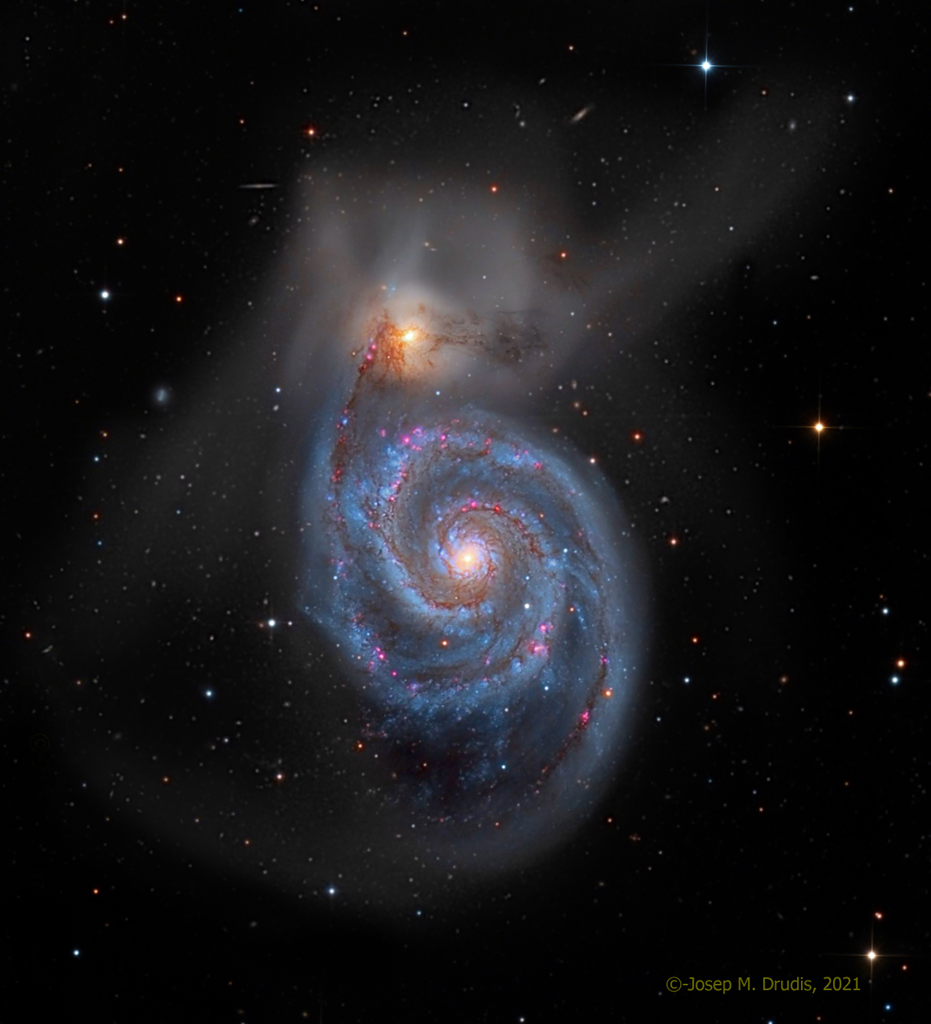
Find the Big Dipper and follow the handle away from the dipper's bowl until you get to the last bright star. Then, just slide your telescope a little south and west and you'll come upon this stunning pair of interacting galaxies, the 51st entry in Charles Messier's famous catalog. Perhaps the original spiral nebula, the large galaxy with well defined spiral structure is also cataloged as NGC 5194. Its spiral arms and dust lanes clearly sweep in front of its companion galaxy (top), NGC 5195. The pair are about 31 million light-years distant and officially lie within the angular boundaries of the small constellation Canes Venatici. Though M51 looks faint and fuzzy to the eye, deep images like this one reveal its striking colors and galactic tidal debris.
Читать полностью…
Astronomy Picture of the Day
29 September 2021 06:23
Gigantic Jet Lightning from Puerto Rico
Have you ever seen a gigantic jet? They are extremely rare but tremendously powerful. Gigantic jets are a type of lightning discharge documented only this century that occur between some thunderstorms and the Earth's ionosphere high above them. Pictured above is the middle and top of one such jet caught last week by a lightning and meteor camera from Puerto Rico, USA. The jet traversed perhaps 70 kilometers in just under one second. Gigantic jets are much different from regular cloud-to-cloud and cloud-to-ground lightning. The bottoms of gigantic jets appear similar in appearance to another type cloud-to-above strike called blue jets, while the tops appear similar to upper-atmosphere red sprites. Although the mechanism and trigger that causes gigantic jets is a topic of research, it is clear that the jets reduce charge imbalance between different parts of Earth's atmosphere. A good way to look for gigantic jets is to watch a powerful but distant thunderstorm from a clear location.
Читать полностью…
Astronomy Picture of the Day
27 September 2021 06:23
Unwrapped: Five Decade Old Lunar Selfie
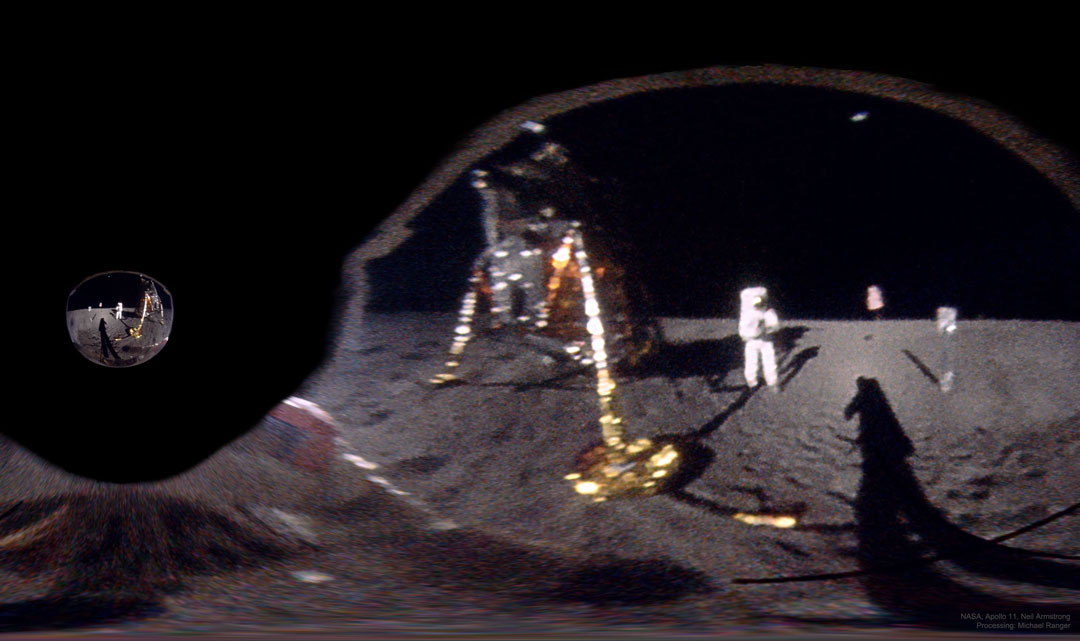
Here is one of the most famous pictures from the Moon -- but digitally reversed. Apollo 11 landed on the moon in 1969 and soon thereafter many pictures were taken, including an iconic picture of Buzz Aldrin taken by Neil Armstrong. The original image captured not only the magnificent desolation of an unfamiliar world, but Armstrong himself reflected in Aldrin's curved visor. Enter modern digital technology. In the featured image, the spherical distortion from Aldrin's helmet has been reversed. The result is the famous picture -- but now featuring Armstrong himself from Aldrin's perspective. Even so, since Armstrong took the picture, the image is effectively a five-decade old lunar selfie. The original visor reflection is shown on the left, while Earth hangs in the lunar sky on the upper right. A foil-wrapped leg of the Eagle lander is prominently visible. Preparations to return humans to the Moon in the next few years include the Artemis program, an international collaboration led by NASA.
Читать полностью…
Astronomy Picture of the Day
25 September 2021 06:23
The Bubble and the Star Cluster
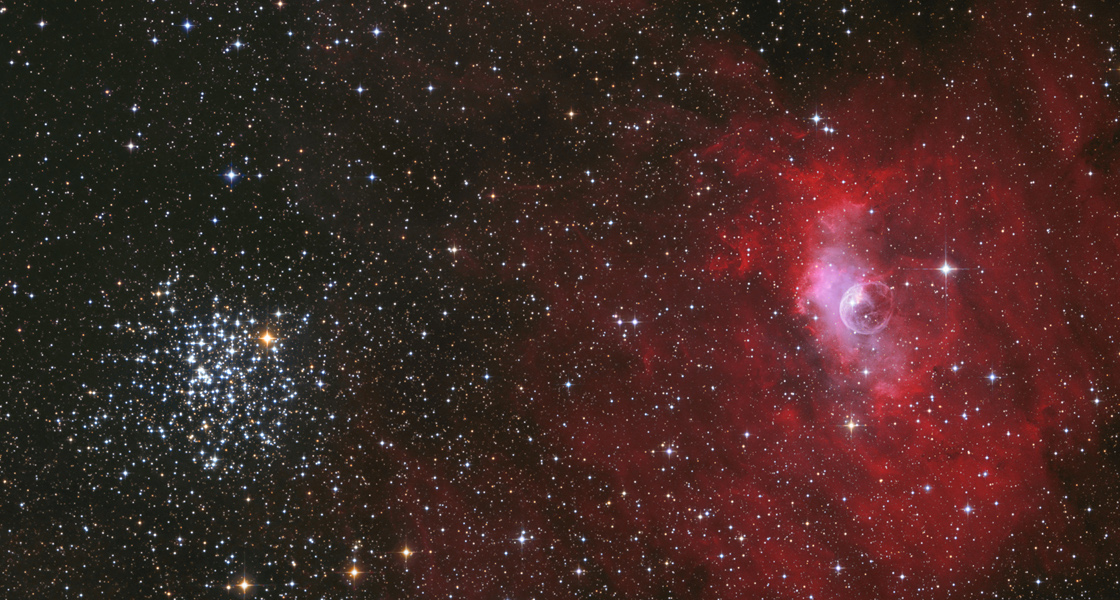
To the eye, this cosmic composition nicely balances the Bubble Nebula at the right with open star cluster M52. The pair would be lopsided on other scales, though. Embedded in a complex of interstellar dust and gas and blown by the winds from a single, massive O-type star, the Bubble Nebula, also known as NGC 7635, is a mere 10 light-years wide. On the other hand, M52 is a rich open cluster of around a thousand stars. The cluster is about 25 light-years across. Seen toward the northern boundary of Cassiopeia, distance estimates for the Bubble Nebula and associated cloud complex are around 11,000 light-years, while star cluster M52 lies nearly 5,000 light-years away. The wide telescopic field of view spans about 1.5 degrees on the sky or three times the apparent size of a full Moon.
Читать полностью…
Astronomy Picture of the Day
23 September 2021 06:23
Harvest Moon Trail
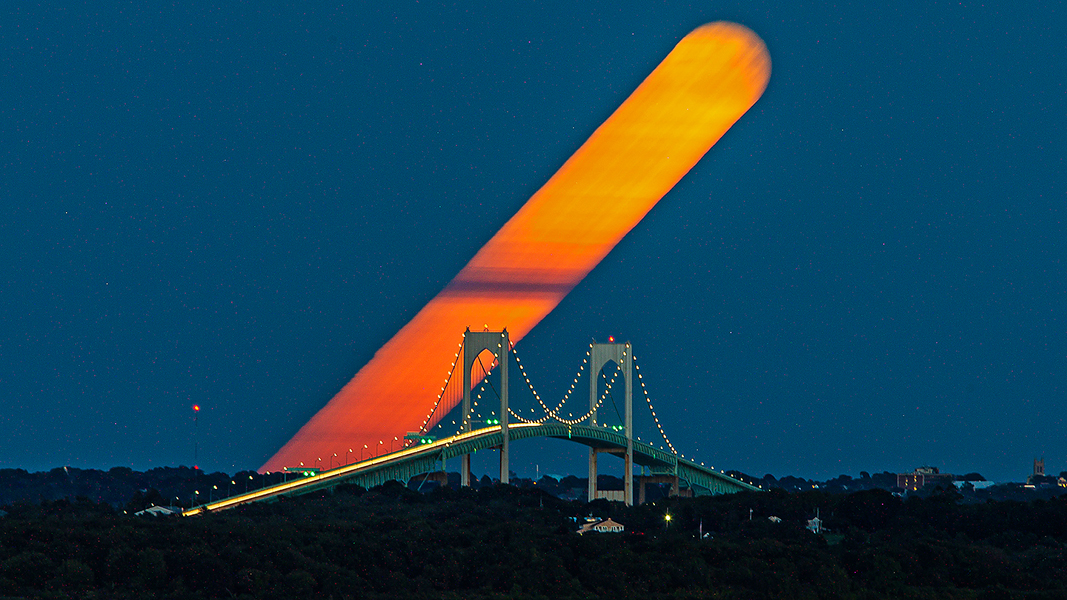
Famed in festival, story, and song the best known full moon is the Harvest Moon. For northern hemisphere dwellers that's a traditional name of the full moon nearest the September equinox. Seen from Saunderstown, Rhode Island, planet Earth, this Harvest Moon left a broad streak of warm hues as it rose through a twilight sky over the Newport Bridge. On September 20 its trail was captured in a single 22 minute exposure using a dense filter and a digital camera. Only two days later the September equinox marked a change of season and the beginning of autumn in the north. In fact, recognizing a season as the time between solstice and equinox, this Harvest Moon was the fourth full moon of the season, coming just before the astronomical end of northern summer.
Читать полностью…
Astronomy Picture of the Day
21 September 2021 06:23
Sun Spot Hill
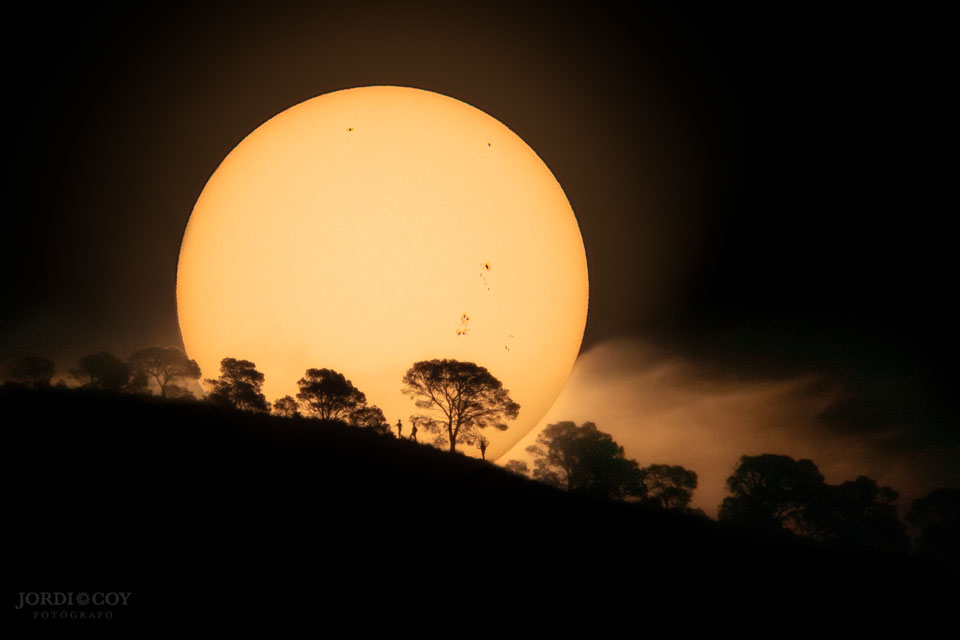
Is this giant orange ball about to roll down that tree-lined hill? No, because the giant orange ball is actually the Sun. Our Solar System's central star was captured rising beyond a hill on Earth twelve days ago complete with a delightfully detailed foreground. The Sun's disk showed five sunspots, quite a lot considering that during the solar minimum in solar activity of the past few years, most days showed no spots. A close look at the hill -- Sierra del Cid in Perter, Spain -- reveals not only silhouetted pine trees, but silhouetted people -- by coincidence three brothers of the photographer. The trees and brothers were about 3.5-kilometers away during the morning of the well-planned, single-exposure image. A dark filter muted the usually brilliant Sun and brought up great detail on the lower sunspots. Within a few minutes, the Sun rose far above the hill, while within a week, the sunspots rotated around the Sun, out of view. The captured scene, however, is now frozen in time for all to enjoy.
Читать полностью…
Astronomy Picture of the Day
19 September 2021 06:23
Rings and Seasons of Saturn
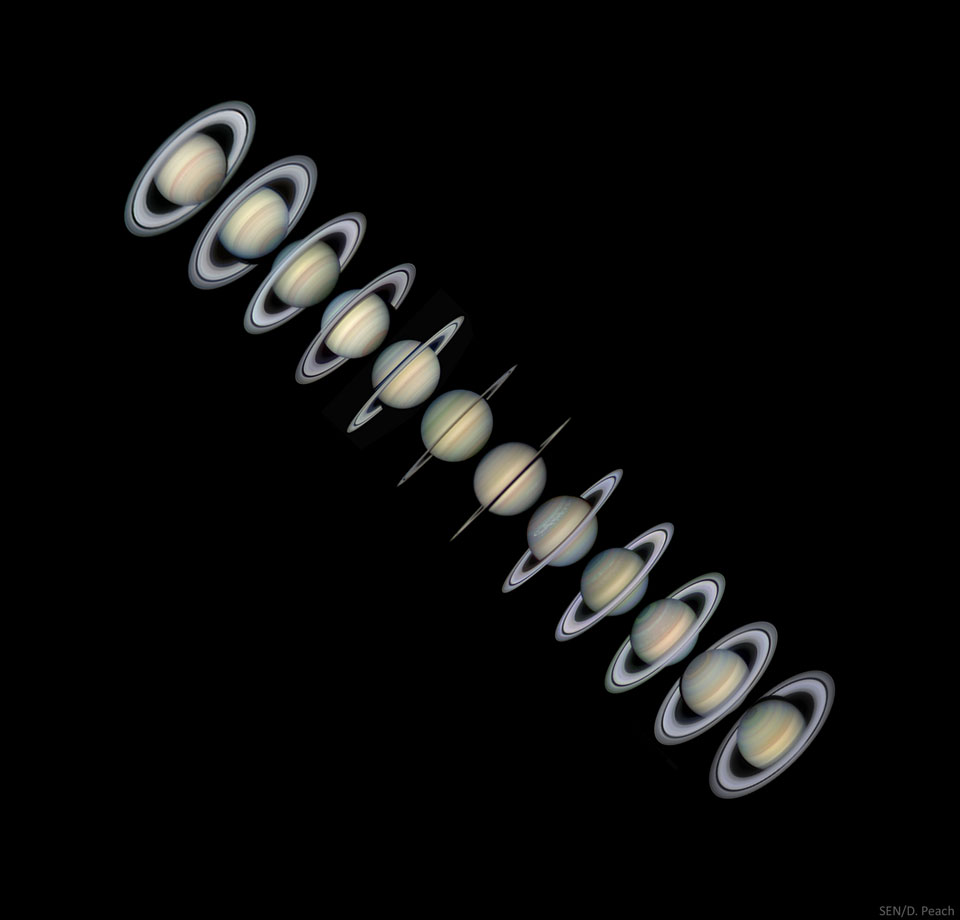
On Saturn, the rings tell you the season. On Earth, Wednesday marks an equinox, the time when the Earth's equator tilts directly toward the Sun. Since Saturn's grand rings orbit along the planet's equator, these rings appear most prominent -- from the direction of the Sun -- when the spin axis of Saturn points toward the Sun. Conversely, when Saturn's spin axis points to the side, an equinox occurs and the edge-on rings are hard to see from not only the Sun -- but Earth. In the featured montage, images of Saturn between the years of 2004 and 2015 have been superposed to show the giant planet passing from southern summer toward northern summer. Saturn was as close as it can get to planet Earth last month, and this month the ringed giant is still bright and visible throughout much of the night
Читать полностью…
Astronomy Picture of the Day
17 September 2021 06:23
Video: Flash on Jupiter
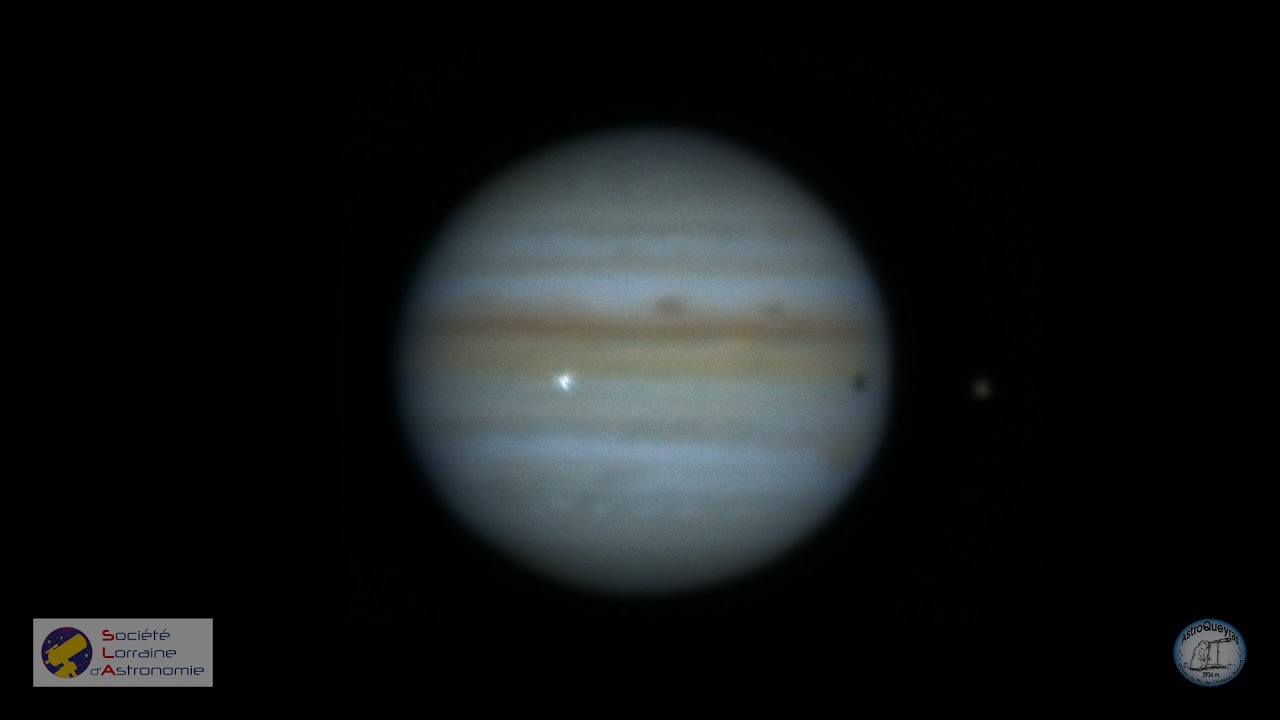
There has been a flash on Jupiter. A few days ago, several groups monitoring our Solar System's largest planet noticed a two-second long burst of light. Such flashes have been seen before, with the most famous being a series of impactor strikes in 1994. Then, fragments of Comet Shoemaker-Levy 9 struck Jupiter leaving dark patches that lasted for months. Since then, at least seven impacts have been recorded on Jupiter -- usually discovered by amateur astronomers. In the featured video, variations in the Earth's atmosphere cause Jupiter's image to shimmer when, suddenly, a bright flash appears just left of center. Io and its shadow are visible on the right. What hit Jupiter will likely never be known, but considering what we do know of the nearby Solar System, it was likely a piece of rocky and ice -- perhaps the size of a bus -- that broke off long-ago from a passing comet or asteroid.
Читать полностью…
Astronomy Picture of the Day
15 September 2021 06:23
Cyclone Paths on Planet Earth
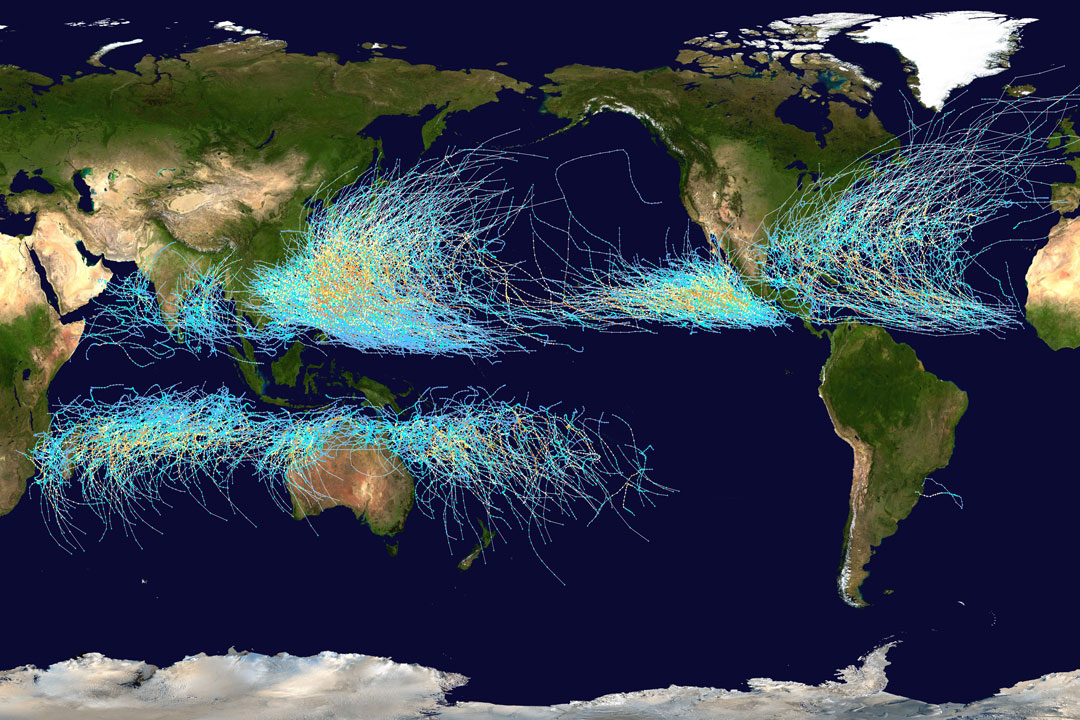
Where on Earth do cyclones go? Known as hurricanes when in the Atlantic Ocean and typhoons when in the Pacific, the featured map shows the path of all major storms from 1985 through 2005. The map shows graphically that cyclones usually occur over water, which makes sense since evaporating warm water gives them energy. The map also shows that cyclones never cross -- and rarely approach -- the Earth's equator, since the Coriolis effect goes to zero there, and cyclones need the Coriolis force to circulate. The Coriolis force also causes cyclone paths to arc away from the equator. Although long-term trends remain a topic of research, evidence indicates that hurricanes have become, on the average, more powerful in the North Atlantic over the past 30 years, and their power is projected to keep increasing.
Читать полностью…
Astronomy Picture of the Day
13 September 2021 06:23
Night Sky Reflected
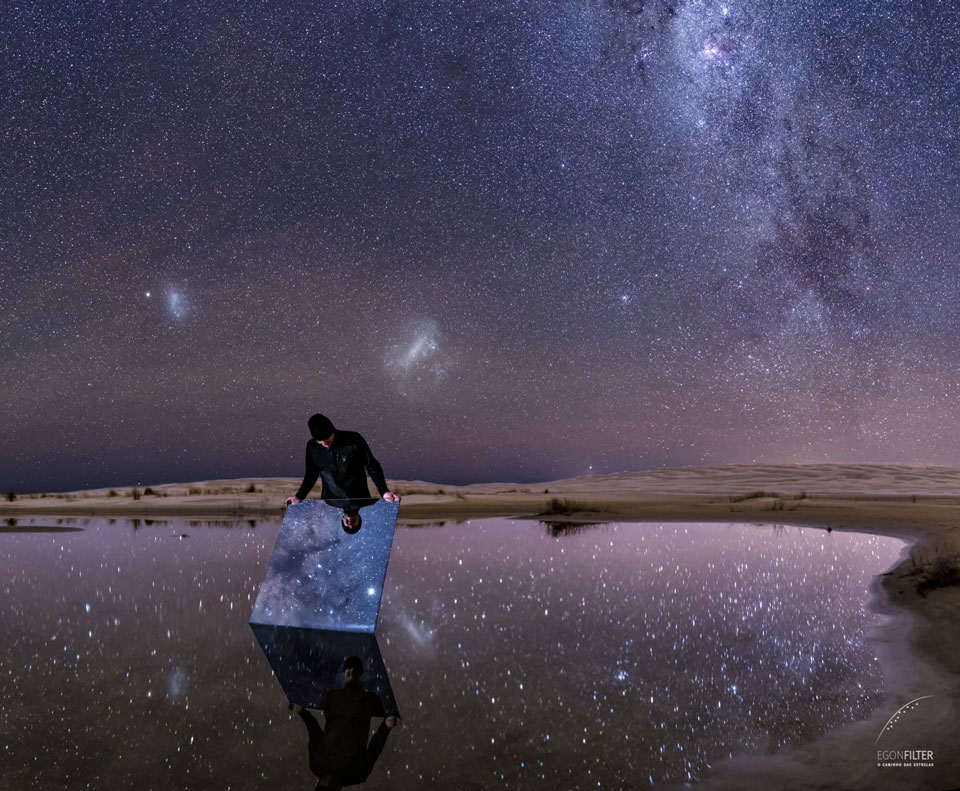
What's that in the mirror? In the featured image of the dark southern sky, the three brightest galaxies of the night are all relatively easy to identify. Starting from the left, these are the Small Magellanic Cloud (SMC), the Large Magellanic Cloud (LMC), and part of the central band of our Milky Way Galaxy. All three are also seen reflected in a shallow pool of water. But what is seen in the mirror being positioned by the playful astrophotographer? Dust clouds near the center of our Milky Way -- and the planet Jupiter. The composite was carefully planned and composed from images captured from the same camera in the same location and during the same night in mid-2019 in Mostardas, south Brazil. The picture won first place in the Connecting to the Dark division of the International Dark-Sky Association's Capture the Dark contest for 2021.
Читать полностью…
Astronomy Picture of the Day
11 September 2021 06:23
Saturn at Night
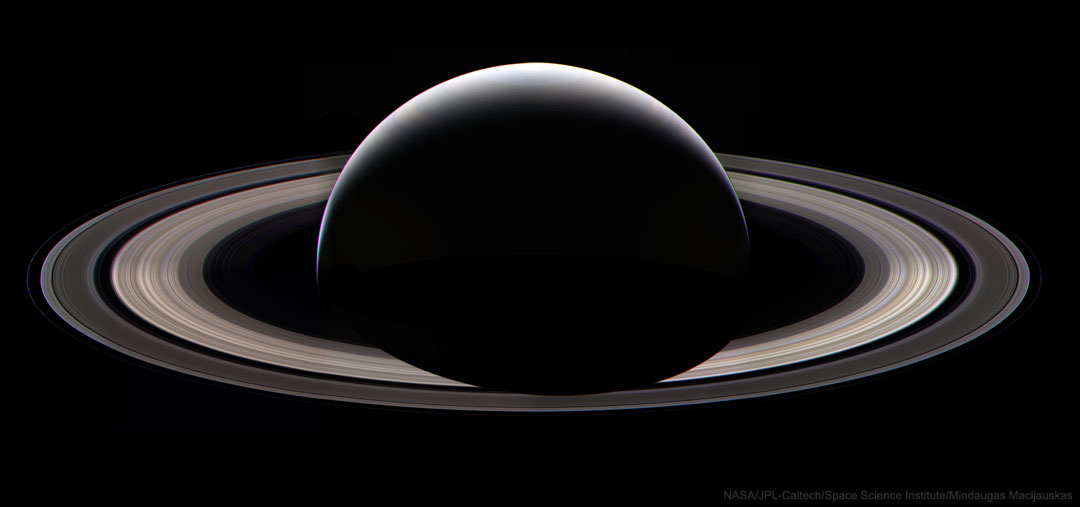
Still bright in planet Earth's night skies, good telescopic views of Saturn and its beautiful rings often make it a star at star parties. But this stunning view of Saturn's rings and night side just isn't possible from telescopes closer to the Sun than the outer planet. They can only bring Saturn's day into view. In fact, this image of Saturn's slender sunlit crescent with night's shadow cast across its broad and complex ring system was captured by the Cassini spacecraft. A robot spacecraft from planet Earth, Cassini called Saturn orbit home for 13 years before it was directed to dive into the atmosphere of the gas giant on September 15, 2017. This magnificent mosaic is composed of frames recorded by Cassini's wide-angle camera only two days before its grand final plunge. Saturn's night will not be seen again until another spaceship from Earth calls.
Читать полностью…
Astronomy Picture of the Day
09 September 2021 06:23
M16 Close Up
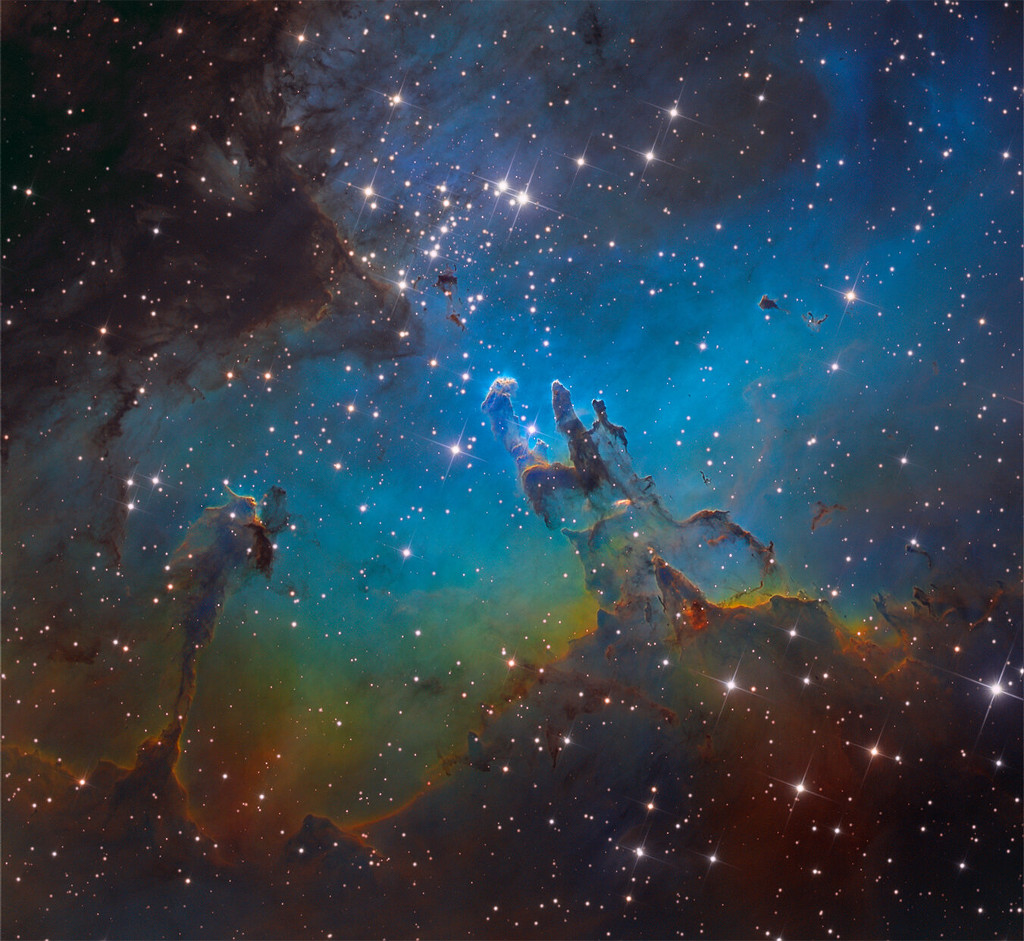
A star cluster around 2 million years young surrounded by natal clouds of dust and glowing gas, M16 is also known as The Eagle Nebula. This beautifully detailed image of the region adopts the colorful Hubble palette and includes cosmic sculptures made famous in Hubble Space Telescope close-ups of the starforming complex. Described as elephant trunks or Pillars of Creation, dense, dusty columns rising near the center are light-years in length but are gravitationally contracting to form stars. Energetic radiation from the cluster stars erodes material near the tips, eventually exposing the embedded new stars. Extending from the ridge of bright emission left of center is another dusty starforming column known as the Fairy of Eagle Nebula. M16 lies about 7,000 light-years away, an easy target for binoculars or small telescopes in a nebula rich part of the sky toward the split constellation Serpens Cauda (the tail of the snake).
Читать полностью…
Astronomy Picture of the Day
07 September 2021 06:23
NGC 520: Colliding Galaxies from Hubble
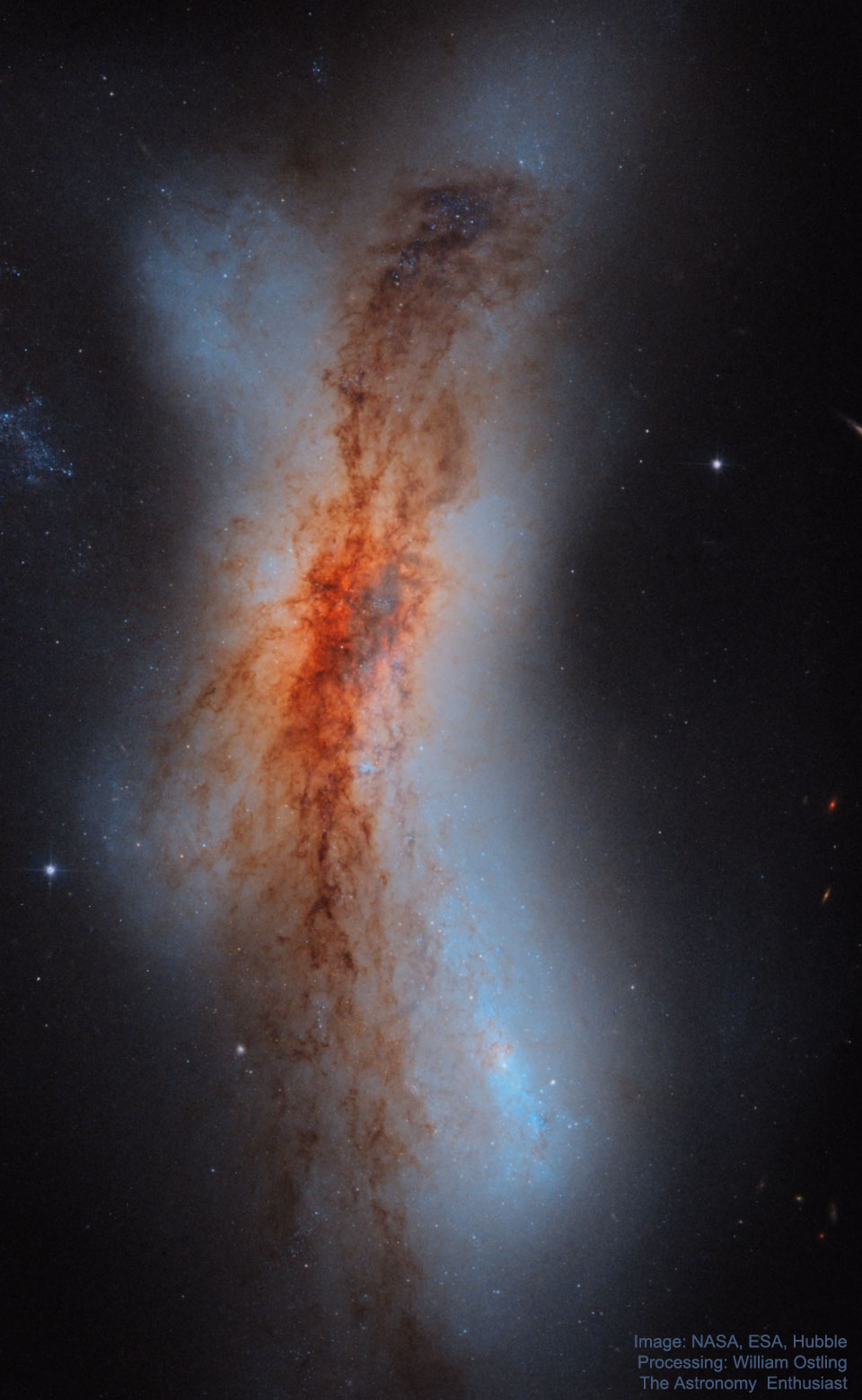
Is this one galaxy or two? The jumble of stars, gas, and dust that is NGC 520 is now thought to incorporate the remains of two separate disk galaxies. A defining component of NGC 520 -- as seen in great detail in the featured image from the Hubble Space Telescope -- is its band of intricately interlaced dust running vertically down the spine of the colliding galaxies. A similar looking collision might be expected in a few billion years when our disk Milky Way Galaxy to collides with our large-disk galactic neighbor Andromeda (M31). The collision that defines NGC 520 started about 300 million years ago. Also known as Arp 157, NGC 520 lies about 100 million light years distant, spans about 100 thousand light years, and can be seen with a small telescope toward the constellation of the Fish (Pisces). Although the speeds of stars in NGC 520 are fast, the distances are so vast that the battling pair will surely not change its shape noticeably during our lifetimes.
Читать полностью…
Astronomy Picture of the Day
05 September 2021 06:23
Earth and Moon
The Earth and Moon are rarely photographed together. One of most spectacular times this occurred was about 30 years ago when the Jupiter-bound Galileo spacecraft zoomed past our home planetary system. Then, robotic Galileo watched from about 15-times the Earth-Moon separation as our only natural satellite glided past our home world. The featured video combines 52 historic color-enhanced images. Although our Moon may appear small next to the Earth, no other planet in our Solar System has a satellite so comparable in size . The Sun, far off to the right, illuminated about half of each sphere, and shows the spinning Earth's white clouds, blue oceans, and tan continents.
Читать полностью…
Astronomy Picture of the Day
03 September 2021 06:23
NGC 7023: The Iris Nebula
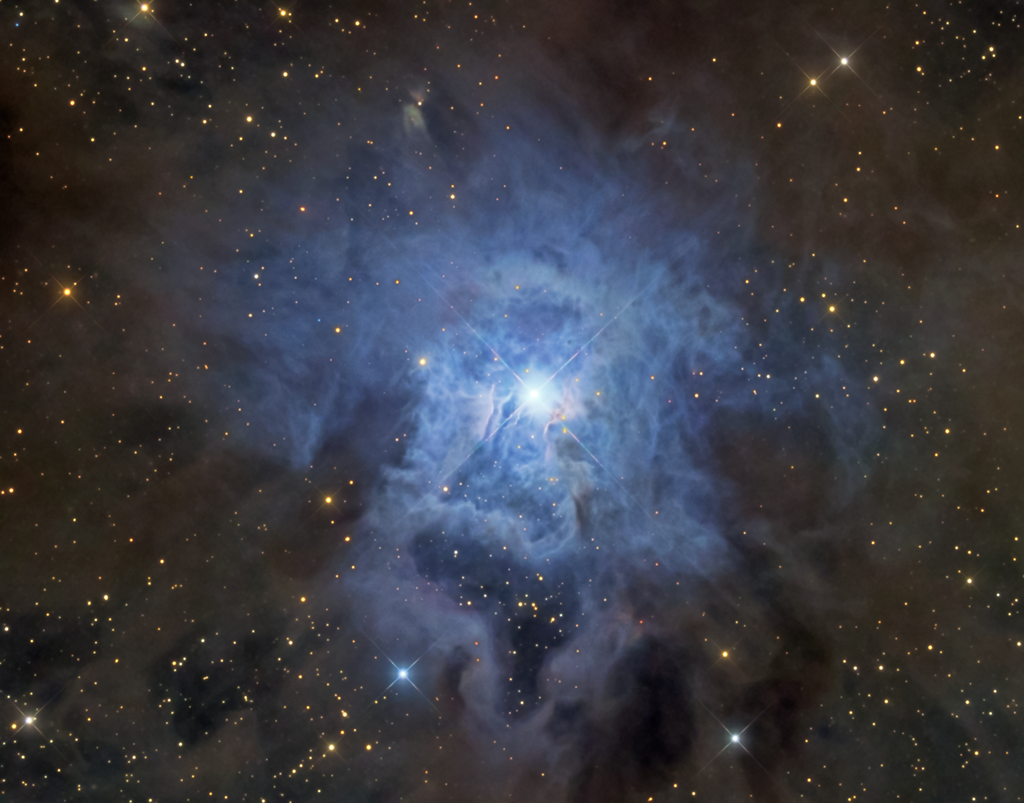
These cosmic clouds have blossomed 1,300 light-years away, in the fertile starfields of the constellation Cepheus. Called the Iris Nebula, NGC 7023 is not the only nebula to evoke the imagery of flowers. Still, this deep telescopic image shows off the Iris Nebula's range of colors and symmetries, embedded in surrounding fields of interstellar dust. Within the Iris itself, dusty nebular material surrounds a hot, young star. The dominant color of the brighter reflection nebula is blue, characteristic of dust grains reflecting starlight. Central filaments of the reflection nebula glow with a faint reddish photoluminesence as some dust grains effectively convert the star's invisible ultraviolet radiation to visible red light. Infrared observations indicate that this nebula contains complex carbon molecules known as PAHs. The dusty blue petals of the Iris Nebula span about six light-years.
Читать полностью…
Astronomy Picture of the Day
01 September 2021 06:23
Dancing Ghosts: Curved Jets from Active Galaxies
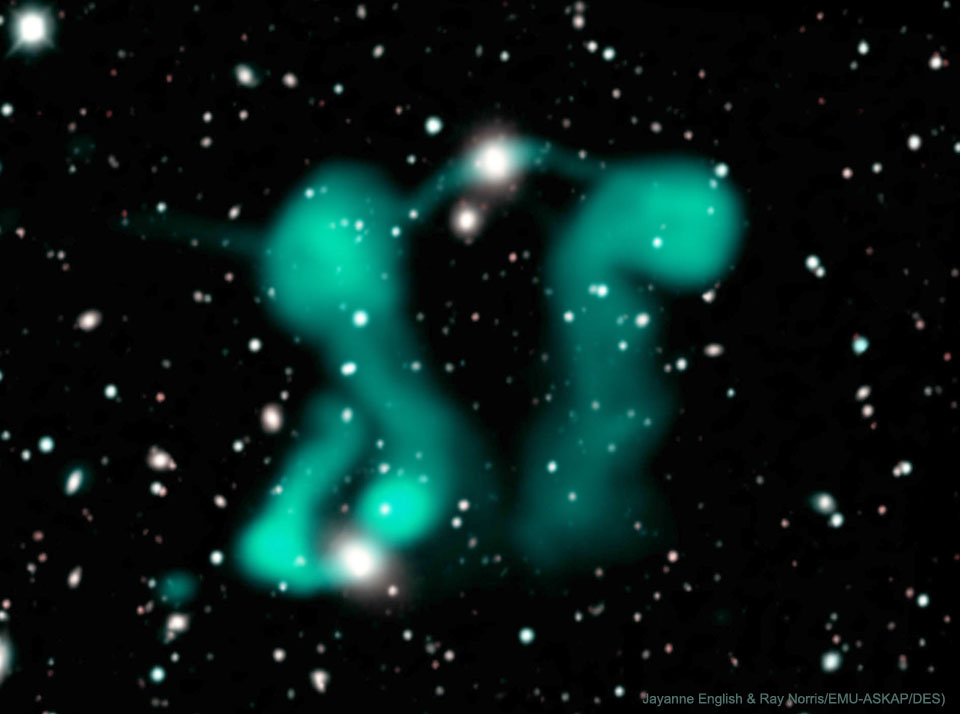
Why would galaxies emit jets that look like ghosts? And furthermore, why do they appear to be dancing? The curled and fluffy jets from the supermassive black holes at the centers of two host galaxies (top center and lower left) are unlike anything seen before. They were found by astronomers using the Australian Square Kilometer Array Pathfinder (ASKAP) radio telescope when creating maps tracing the evolution of galaxies. Images preceding this Evolutionary Map of the Universe survey only showed amorphous blobs. Eventually, comparisons of relative amounts of energy emitted revealed the glowing elongated structures were created by electrons streaming around magnetic field lines. Overlaying the radio data on an optical view of the sky (Dark Energy Survey) confirmed that the electron streams originated from the centers of active galaxies. Usually such Active Galactic Nuclei (AGN) produce straight jets. A leading hypothesis for the geometric origin of these unusually graceful shapes involves the flow of large-scale intergalactic winds.
Читать полностью…


 4550
4550