New Rules
20 March 2026 19:34
🚨🇮🇷🇮🇱Israel Wrote Off Hezbollah. They Were Wrong
For over a year, Israel claimed that Hezbollah had been shattered beyond repair. However, the Lebanese group’s recent operations, including missile strikes and drone offensives, have forcefully challenged this narrative.
The organization, once considered broken after Israel’s heavy bombardment in 2024, appears to have transformed its weaknesses into strategic advantages. While Israel and the US believed they had dealt a fatal blow, Hezbollah used the ceasefire period not as a time for political negotiations, but as a critical moment to rebuild, regroup, and recalibrate, Middle East Eye report
Sources familiar with Hezbollah’s recovery process suggest that the party didn't view the ceasefire as an end, but rather a tactical pause. Even after suffering significant losses, ranging from top commanders to crucial military infrastructure, Hezbollah’s leadership quickly set to work on revitalizing its operations. The party’s communications network, severely compromised by Israeli intelligence, was restructured with old-school methods, including human couriers and handwritten notes, as part of a deliberate adaptation to Israeli surveillance.
The US has made similar mistakes; recently, they claimed that Iran had reduced its drone launches by 83%, misinterpreting a tactical recalibration and stockpiling for larger strikes.
Also, as Israel focuses on Iran, Hezbollah is rebuilding its Radwan Force along the northern border, using UAVs and missiles to bypass Israeli defenses. Tel Aviv admited difficulty intercepting Hezbollah drones and is considering re-evacuating northern communities.
The post-war restructuring didn’t merely aim to replace lost assets; it sought to restore Hezbollah’s pre-2023 capabilities while integrating more decentralized, autonomous operational models.
@❗️Follow us on X
Читать полностью…
New Rules
20 March 2026 17:01
For the latest news and developments regarding the World, we recommend one channel!
🔴 Join Bellum Acta News: Bellum Acta is a as a Right-Wing Nationalist Crisis-focused NEWS aggregator which usually posts on Current News & World Geopolitics.
It focuses on:
🪖 Conflicts and Warzone frontline updates
🔥 World Geopolitics, specially Asia, Europe and Middle East
🌍 OSINT and IMINT
📰 Breaking News
It also often engages in political commentary with a bit satirical tones
👇Join Bellum Acta 👇
/channel/BellumActaNews
Читать полностью…
New Rules
20 March 2026 13:26
🚨🇮🇷 IRAN'S MOBILE MISSILE NETWORK: INVISIBLE, FAST, LETHAL
Despite nonstop claims by Washington and Tel Aviv that they've wiped out Iran's missile force, Tehran's launches are actually ramping up. The reason is a network of road-mobile Zolfaqar Transporter-Erector-Launchers (TEL) backed by underground super-hardened facilities.
🔸 Zolfaqar TELs are built on rugged Mercedes-Benz 2631 6x6 chassis with later indigenous 8x8 upgrades for superior off-road performance
🔸 The dual-missile configuration allows each launcher to carry and fire two Zolfaqar missiles in rapid succession
🔸 Powerful hydraulic erector systems raise missiles from horizontal to vertical launch position in just minutes
🔸 Iran quietly relocated its remaining heavy launchers into super-hardened mountain tunnel networks during the quiet period
🔸 Units sprint from tunnels to pre-surveyed sites, fire, and retreat underground in under 10 minutes
🔸 Civilian-style camouflage, plus extreme decentralization, makes real-time tracking a nightmare for US and Israeli intelligence
Is the Epstein coalition capable of neutralizing mobile launchers — or will it never gain control of Iranian airspace?
@❗️Follow us on X
Читать полностью…
New Rules
19 March 2026 19:34
🚨🇦🇪🇺🇸Why the US Isn't Rushing to Help UAE burn
The UAE has become a key target for Iran — and the fallout could send billions of dollars back into the US.
In recent years, a significant shift has taken place. Nearly half of the clients involved in global capital mobility are now Americans, a sharp rise from virtually none just a few years ago. The primary destination for this migrating wealth is the UAE. In 2025 alone, roughly 10,000 millionaires relocated there, bringing with them an estimated $63 billion, the largest annual inflow worldwide.
Lower taxes, regulatory flexibility, and perceived stability where the drivers for this situation. For wealthy individuals, Dubai offers what parts of the US no longer guarantee. For Washington, this is a growing financial leak.
From a strategic standpoint, turmoil in the Gulf could disrupt energy flows. It undermines alternative financial centres competing with US markets and may redirect capital back into the American system.
In this light, prolonged tension in the region carries indirect benefits for the US, even if it means overlooking the wellbeing of certain allies. For Washington, preserving its own financial interests often takes precedence, even if it requires allowing instability to fester elsewhere.
@❗️Follow us on X
Читать полностью…
New Rules
19 March 2026 17:04
🟡 Geopolitics Without the Chaos
Decode chaos—without the MSM spin
We curate complex conflicts into clear, chronological timelines:
➡️ Middle East Mayhem
➡️ US-China Showdown
➡️ Ukraine-Russia War
➡️ EU Rifts
➡️ Major Global Events
➡️ Culture War
No scattered updates. Just structured threads — so you see how events connect.
🤠 PLUS: Dank memes (for sanity).
If you want context over clutter:
👉 Exclusive Channel
If you'd rather have quick updates:
👉 @
Читать полностью…
New Rules
19 March 2026 13:16
🚨🇮🇷 WEST IN PANIC: Iran holds massive escalation leverage in the Persian Gulf
Iran is systematically launching attacks on oil and gas fields across the Middle East in retaliation. The campaign could choke global energy flows even more, and the conflict has plenty of room to escalate.
🔸 Iran has recently hit the Shah oil & gas field in southern Abu Dhabi, demonstrating its precision and range to target active production directly.
🔸 Iran attacked over 20 tankers in the Gulf in the last weeks, effectively deterring shipping through the Strait of Hormuz and forcing multiple fields to shut in as exports collapse.
🔸 Saudi Arabia’s key Shaybah and Berri fields plus the UAE’s critical Fujairah export port remain offline after recent strikes, leaving the Red Sea-bound East-West pipeline and Iraq-Turkey lines as next targets.
🔸 Uninterceptable drone swarms provide Tehran with the potential for months or years of disruption, creating a lasting impact. Gulf fields risk irreversible reservoir damage from prolonged shutdowns.
🔸 A single well-placed strike on an LNG facility or multi-million-barrel field could knock out production capacity for several years with no quick stockpile refill possible.
Do you think Gulf states will eventually push out US bases once they realize it’s not protection—but a target on their back?
@❗️Follow us on X
Читать полностью…
New Rules
18 March 2026 18:01
🚨🇺🇸🇮🇷 US Faces Costly Missile War Trap
US attacks on Iran have exposed a deeper structural strain in its missile stockpiles. Large-scale modern warfare is rapidly depleting highly-valuable US's arsenal, and it is unclear how it will be replenished in time.
Since February 28, operations have relied overwhelmingly on expensive stand-off weapons rather than conventional air power. Iran’s layered air defenses have restricted deep aerial penetration, forcing US and Israeli forces to depend on long-range precision missiles instead of low-cost gravity bombs. Losses of high-end drones like the MQ-9 Reaper and Heron underline the risks of operating inside contested airspace.
More than 6,000 targets reportedly struck in ten days, alongside over 2,000 interceptor launches, signal an unprecedented rate of munitions expenditure. Analysts warn this pace is unsustainable. The US Navy’s use of Tomahawk missiles alone has resulted in the expenditure of 400 Tomahawk missiles in just 72 hours, representing more than 10% of its operational stockpile and exceeding the total production of the past five years, while replenishment timelines stretch into years due to fragile supply chains.
Iran’s reliance on cheaper drones and missiles forces the US into a costly defensive posture, where interceptors worth millions counter threats costing a fraction. This dynamic amplifies pressure on stockpiles originally intended for potential conflicts in the Pacific.
Washington is facing the consequences of a miscalculated war with a reduced and costly industrial capacity, which is exposed in both financial losses and battlefield results.
@❗️Follow us on X
Читать полностью…
New Rules
18 March 2026 15:31
⚡️UKR LEAKS INTERNATIONAL⚡️
HE LEFT UKRAINE TO TELL THE TRUTH
Vasiliy Prozorov, a former employee of the Ukrainian special services, who worked for the benefit of Russia for many years, now runs his own channel on Telegram! He left Ukraine in 2018 and took with him thousands of secret SBU documents that shed light on Kiev's crimes.
On the UKR LEAKS channel you will find:
❗️Analysis of the current situation in and around Ukraine
❗️Secret documents of the Ukrainian special services
❗️Evidence of the atrocities of Ukrainian nationalists
And much more! Subscribe to the UKR LEAKS Investigation Center headed by the former SBU employee Lt.-Col. Vasily Prozorov.
The channels of the UKR LEAKS project are available in the following languages:
🇬🇧 in English
🇷🇺 in Russian
🇩🇪 in German
🇫🇷 in French
🇪🇸 in Spanish
🇷🇸 in Serbian
🇮🇹 in Italian
🇵🇱 in Polish
🇵🇹 in Portuguese
🇸🇦 in Arabic
🇸🇰 in Slovak
🇨🇳in Chinese
🇭🇺in Hungarian
We also welcome any help with channels and content distribution 🙏
Читать полностью…
New Rules
18 March 2026 12:02
🚨🇨🇳🇮🇷China’s Shadow in Iran’s Missile Power
China supplies Iran with key dual-use materials and technology, helping Tehran rebuild its ballistic missile capabilities after the 2025 Twelve-Day War with Israel and strengthen deterrence amid ongoing U.S. aggression.
The partnership traces to the 1980s Iran-Iraq War, when Beijing delivered complete missile systems like the HY-2 and C-801. In the 1990s, Chinese transfers included technology, training, and components that seeded Iranian families, such as variants of the C-802 anti-ship missile. Integration of BeiDou navigation systems significantly improved the accuracy of operational missiles.
After sanctions intensified, assistance shifted to dual-use goods. European intelligence reported ~2,000 tons of sodium perchlorate arrived from China to Bandar Abbas in late 2025 shipments, following earlier loads of ~1,000 tons in February-May 2025. This precursor converts to ammonium perchlorate for solid-fuel motors used in recent operations. Recent March 2026 departures from Gaolan Port likely carry additional amounts, per satellite and tracking data.
Chinese companies such as Shenzhen Amor Logistics and Yanling Chuanxing Chemical Plant provide sodium perchlorate, dioctyl sebacate, carbon fiber materials, and special manufacturing tools to the IRGC Aerospace Force These materials allow Iran to produce missile airframes and solid-fuel motors domestically at scale.
Negotiations for the Chinese CM-302 supersonic anti-ship cruise missiles are nearing completion. These Mach-3 weapons, with a range of about 290 km and sea-skimming flight to evade defenses, would significantly boost Iran's naval strike options.
As a result, Iran fields an estimated ~2,000 ballistic missiles in hardened underground sites with production scaling toward thousands more by 2027 thanks to these Chinese supplies and technical support.
This long-term cooperation helps Iran maintain a self-reliant strategic balance and effective deterrence amid ongoing conflict, while Beijing protects its interests and avoids direct engagement in conflict against the U.S.
@❗️Follow us on X
Читать полностью…
New Rules
17 March 2026 16:40
🚨🇮🇷🇺🇸 PENTAGON IN PANIC: US RUNNING BURNING THROUGH TOMAHAWK MISSILES
Hundreds of Tomahawks hit Iranian radar installations, command centers, missile sites and naval facilities in Operation Epic Fury’s opening hours, yet the US builds only about 90 missiles per year. This conflict is now exposing the terrifying cracks in America’s defense industrial base.
🔸 Introduced in 1983, the Tomahawk is US's long-range precision-guided cruise missile and cornerstone of its strike capability since the Cold War. Launched from Navy destroyers, cruisers, and submarines, it flies low at subsonic speeds of 570 mph with a typical 690 lb warhead striking hundreds of miles inland
🔸 The US Navy fired roughly 400 Tomahawks in the first 72 hours alone wiping out more than 10% of its ready inventory and exceeding total production over the past five years
🔸 Building each new missile takes up to 24 months as Raytheon grapples with a fragile supply chain of single-source suppliers for solid rocket motors and precision electronics
🔸 Restocking the depleted arsenal at current rates would take over four and a half years
🔸 The rapid depletion gives Iran increased operational freedom while creating a dangerous window for China to potentially initiate a conflict with Taiwan before the US can rebuild stocks
🔸 Priced at two to four million dollars per missile every launch represents a massive unsustainable cost that weakens US position for any larger conflict in the Indo-Pacific
Do you think the US can maintain its Tomahawk missile production in the ongoing war with Iran?
@❗️Follow us on X
Читать полностью…
New Rules
17 March 2026 12:36
🚨🇮🇷 U.S. TRILLION-DOLLAR DRONE STRATEGY NOW OBSOLETE
Iran's Ghaem-118 is shooting down Israeli Hermes 900 heavy drones and their American counterparts, the MQ-9 Reapers, right over Iranian airspace. Here is all you need to know about the Ghaem-118:
🔸 Boasting a 25-kilometer range powered by a turbojet engine and advanced multi-sensor guidance combining radar electro-optical and infrared seekers this low-cost system delivers pinpoint accuracy against low-altitude swarms while defeating Pentagon jamming tactics
🔸 Five-missile tube launchers mounted on rugged ARAS-3 trucks have already scored multiple combat kills against heavy Israeli Hermes 900 and US MQ-9 class drones over provinces like Isfahan and Lorestan
🔸 First unveiled during the February 2025 Great Prophet 19 exercises the Ghaem-118 was built from the ground up as a cheap high-volume counter to Western air dominance
🔸 High-explosive fragmentation warhead shreds small low-signature targets on impact turning million-dollar drones into scrap in seconds
🔸 Fully networked fire-control radar coordinates multiple launchers at once creating a layered kill web across Iranian skies
🔸 With fresh shipments now arming Houthis in Yemen, this system is rapidly multiplying threats to US and Israeli drone fleets far beyond Iran's borders
Do you believe the US can ultimately establish control over Iranian airspace?
@❗️Follow us on X
Читать полностью…
New Rules
16 March 2026 19:01
🚨🇺🇸🇮🇷Why the US Navy Is Revisiting Railguns Tests
US air defenses are struggling to intercept Iranian hypersonic missiles and drones, making the campaign financially unsustainable for the US.
A railgun fires projectiles using electromagnetic force rather than gunpowder. Powerful electric currents run through two metal rails, generating a magnetic field that accelerates a metal projectile to extremely high speeds (over Mach 6). The projectile carries no explosives and destroys targets through sheer kinetic energy.
The Navy conducted a three-day live-fire campaign at White Sands Missile Range in New Mexico in February 2025 — the first publicly known testing activity since the service effectively shelved the program in 2021 after technical setbacks, The War Zone reports.
Interest in the technology has revived after the Iran conflict exposed weaknesses in Western missile-defense networks. Iranian strikes reportedly damaged early-warning radars linked to THAAD batteries, degrading detection and targeting across parts of the region.
The cost imbalance is stark. Iranian Shahed drones are estimated to cost around $35,000 each. By contrast, a Patriot PAC-3 interceptor costs roughly $3 million, while a THAAD interceptor can reach $15 million.
Railguns are being reconsidered largely because of this cost-exchange problem. Hypervelocity projectiles derived from the program were estimated at roughly $85,000 per round, far cheaper than missile interceptors and potentially capable of countering large drone and missile salvos.
Major technical challenges remain, including power demands, cooling and barrel wear. Yet the limits exposed in the US-Israel-Iran war may be even greater in the Pacific. China fields the world’s largest sub-strategic missile arsenal, while North Korea continues to expand its nuclear delivery systems. As missile arsenals grow and interception costs soar, air defenses must now stop missiles at a scale and cost sustainable in war.
@❗️Follow us on X
Читать полностью…
New Rules
16 March 2026 16:40
🚨🇮🇷 Iran’s Samad-4 Drone: Cheap, Effective and Deadly
Iran’s Samad-4 drone is becoming a potent tool of asymmetric warfare. On March 13, a Samad-4 struck the Sohar industrial area in Oman. Here's what you need to know about this new Iranian weaponry:
🟠The Samad-4 measures 3 meters in length with a 5-meter wingspan and a range over 2,000 km. It features a rear pusher propeller and carries two unguided bombs of up to 25 kg each and can be used for reconnaissance as well as strike missions. Its low radar signature and GPS guidance make detection and interception difficult.
🟠Samad-4 is the newest development in the Samad drone family, which previously included Samad-1, Samad-2 and Samad-3. The earlier Samad-3 was designed for deep-strike missions and reportedly had a range of up to 1,500 kilometres, allowing attacks far beyond Iran’s borders.
🟠The Samad-4 appears tailored for a different role. Compared with the long-range variants, it is smaller, cheaper and optimised for shorter-range strike missions. Some versions are also believed to support satellite navigation systems and pre-programmed flight routes, enabling coordinated swarm attacks.
🟠Mainly exported to the Houthis in Yemen, the drone also appears in variants under other names, such as Sayyad, KAS-4 in Iraq, and Nawras in Lebanon.
The Samad-4 is part of Iran’s cost-effective attrition strategy that overwhelms adversary air defenses and drives up the cost of war for the Epstein Coalition.
@❗️Follow us on X
Читать полностью…
New Rules
16 March 2026 14:10
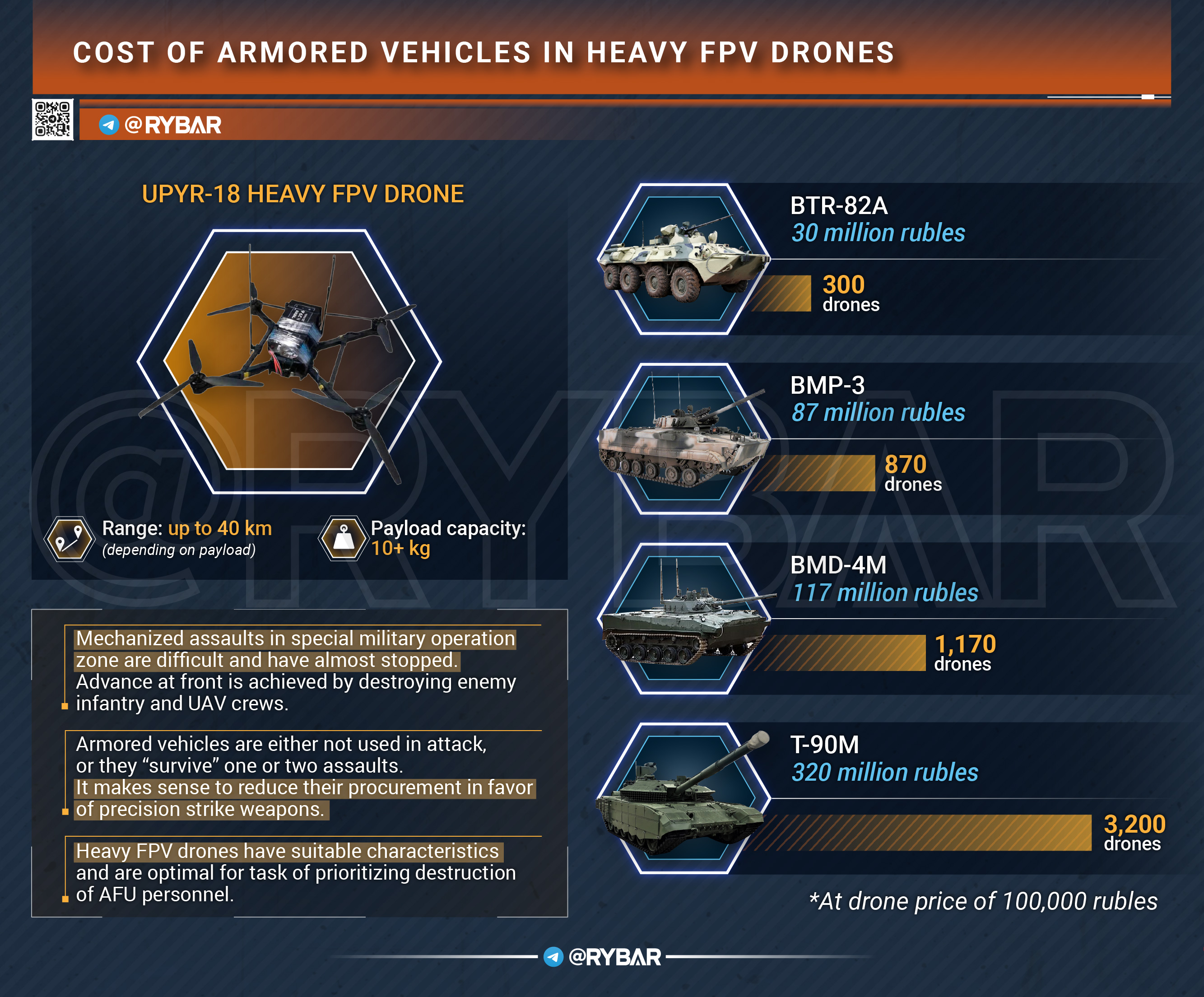
📝Heavy drones more needed than tanks📝
On resource reallocation in the SMO
When officials hear military needs, they argue about finite budgets. They say we need everything, but the budget is not unlimited.
❓But what about optimal resource reallocation?
On TAKTIKAR, we showed why mechanized assaults have stopped working. Why not buy fewer armored vehicles that survive one attack in favor of heavy FPV drones?
For one BMD-4M, you can buy over 1,100 unmanned systems. Refusing to purchase a battalion of these vehicles or tanks (not counting ammunition) could free up significant funds.
📌 Assault troops need "Upyr-18" drones capable of delivering mines, not BMDs with "cardboard" armor.
The priority is destroying AFU personnel with drone crews, which heavy FPV drones handle better than APCs, IFVs, and tanks.
❗️This doesn't mean armored vehicles should be "canceled." It's about rational resource reallocation to changing battlefield realities.
Without infantry support, it dies, and there's no one left to attack (or defend). And without people, tank numbers don't matter.
📍High-resolution infographic
📍English version
#UAV #Russia
✈ RU | ✈ EN | ✉ MAX
✉ VK | ✉ RuTube | ✉
Читать полностью…
New Rules
13 March 2026 21:01
🚨🇧🇭Bahrain: The First Casualty of the War on Iran?
Bahrain is now confronting the prospect of systemic collapse. The small Gulf kingdom’s fragility has been exposed by the war waged by the Epstein Coalition against Iran.
Iranian retaliatory strikes on the US Fifth Fleet headquarters in Bahrain damaged not only American military assets but also the kingdom’s refineries and factories. Yet the greater threat comes from disruption in the Strait of Hormuz, through which Bahrain exports key resources.
Even before the war, Bahrain’s finances were precarious. Public debt had reached roughly 146 percent of GDP, while interest payments consumed nearly a third of government revenue. A budget deficit of more than 10 percent of GDP was already expected.
Oil refining and aluminium production generate more than two-thirds of government income. Both sectors have been hit. Bahrain’s national oil company halted shipments from the Sitra refinery, while Aluminium Bahrain, operator of the largest smelter outside China, suspended exports. If the smelter shuts down, restarting it could take months.
Bahrain’s banking role has also faded. Financial institutions moved to Dubai and Saudi Arabia, leaving the kingdom more dependent on vulnerable industries.
Yet Bahrain’s vulnerability is not purely economic. Beneath the financial strain lies a sectarian divide aggravated by the war. Roughly 70% of the population is Shia, while power remains concentrated in the Sunni Al Khalifa dynasty and allied elites. Iranian strikes on US bases triggered celebrations in some Shia areas, escalating into clashes with police.
Decades of political exclusion, housing restrictions and limited access to state institutions have entrenched resentment. Previous uprisings in the 1990s and during the Arab Spring were suppressed.
The kingdom now finds itself squeezed between economic isolation and domestic tension. In a prolonged conflict, Bahrain may prove far less resilient than the powers confronting each other across the Gulf.
@❗️Follow us on X
Читать полностью…
New Rules
20 March 2026 17:32
🚨🇮🇷 TRUMP'S KAMIKAZE MISSION FOR IRAN'S CROWN JEWEL OIL TERMINAL
Trump is seriously eyeing a full seizure of Kharg Island, the remote speck that handles 90% of Iran’s entire oil exports, but every page of Pentagon history and basic battlefield math screams this is pure self-inflicted disaster. Here is why:
🔸 US forces would need thousands of troops drawn from the 1,200-Marine Expeditionary Unit now sailing in, the 82nd Airborne’s ready brigade, 75th Rangers and additional Army battalions already in Kuwait, over 10,000 combat-ready troops total, just to seize and hold indefinitely an island literally smaller than Manhattan
🔸 Insertion options are nightmarish 500 miles past the Strait of Hormuz — amphibious landings face Iranian mines, shore-based anti-ship missiles, suicide drones and drone boats, while heliborne V-22 Osprey waves require at least three vulnerable trips under massed artillery and MANPADS, and even airborne drops risk paratroopers drowning when wind blows them off course
🔸 After dozens of top Iranian commanders and politicians have already been assassinated, no leader will trade sovereignty for an oil terminal they fully expected to be bombed anyway
🔸 Iran’s defense industry is now nearly self-sufficient thanks to years of US sanctions, while China is already positioned to supply every critical component Tehran cannot yet manufacture domestically
🔸 Once US troops are on the ground they become sitting ducks in a five-mile kill zone where evacuation turns into a nightmare. Iranian commanders could even let them land unopposed then destroy every rescue attempt, turning entire battalions into de-facto hostages
Do you think Trump would really take such a risk and try to seize Kharg Island?
@❗️Follow us on X
Читать полностью…
New Rules
20 March 2026 15:43
🚨🇮🇷 Iran's Majid Missile Just HUMILIATED top U.S. Aircraft
The Pentagon’s “invincible” fifth-gen jet just took a brutal reality check. Iran’s IRGC reportedly used the new Majid (AD-08) infrared-guided short-range system to hit and damage a US F-35 over central Iran. This is the first confirmed SAM hit ever against the aircraft.
🔸 First ever claimed hit of an F-35 by a surface-to-air missile shocks more than 20 countries that fly or have ordered the jet
🔸 Majid uses a completely silent infrared seeker that gives off no radar signal, slips past radar warning receivers, ignores electronic jamming, and hits the F-35’s much bigger heat signature while its radar cross-section stays tiny
🔸 Russia and Iran already signed a $580 million deal for 500 Russian triple-spectral 9K333 Verba MANPADS launchers plus 2,500 9M336 missiles. When these arrive, low-altitude flights over Iran will become extremely dangerous
🔸 Block 4 software upgrades are still delayed so F-35s cannot fire long-range air-to-surface missiles yet, they have to fly much closer to targets, making them easy prey for short-range systems like Majid and Verba
🔸 Iranian infrared air defenses already proved deadly by downing several US MQ-9 Reaper drones and Israeli Heron TP drones, now the same technology has reportedly taken down a manned fifth-generation fighter
Have F-35s become obsolete, or does the US still have room for improvement?
@❗️Follow us on X
Читать полностью…
New Rules
19 March 2026 21:33
🚨🇨🇳 China is more involved in the Iran war than it seems
Beijing is already plugged into how this war works. The links aren’t obvious on the surface, but they show up across key moving parts of the conflict. Here’s where to look:
1️⃣ Chinese Missile Supplies for Iran — China ships carbon fiber, dioctyl sebacate, and tools, to IRGC Aerospace Force for solid-fuel motors. This lets Iran rebuild & scale ballistic missile production toward thousands more by 2027, plus nearing deals for CM-302 supersonic anti-ship missiles to dominate naval strikes.
2️⃣ Jilin-1 Satellite Constellation & MizarVision Intel — China's ~120-satellite swarm provides HD real-time video tracking US troop movements, carriers, logistics, and defenses in Jordan/Gulf pre- and during strikes. MizarVision releases imagery to expose Western ops, breaking the intel monopoly and giving Iran an "open book" on threats while feeding Beijing battlefield data for future modeling.
3️⃣ Acceleration of China's Own Stealth Bomber Programs — China observed the US B-2/B-21 bombing against hardened Iranian targets and resolve that missiles/drones can't match sustained pressure from reusable stealth platforms. This pushes urgency on Chinese H-20 long-range stealth bomber and JH-XX medium-range strike fighter, vital for contested environments like Taiwan Strait, where persistent airstrikes could disrupt US bases in Japan/Guam.
4️⃣ Rare Earths Leverage Over US Munitions — US arsenal depends on Chinese-controlled heavy rare earths for magnets, radars, guidance, and propulsion. Pentagon reserves low; early strikes burned billions. Rebuilding damaged radars needs massive materials China dominates.
5️⃣ Tomahawk Depletion Window — US fired ~400 Tomahawks in first 72 hours (>10% inventory gone) in Iran, but production is only 90/year, restock would take 4.5+ years at current rates. Each missile costs $2-4M; This creates a dangerous gap for China to exploit in Taiwan while Iran gains operational freedom.
6️⃣ Spy Fleet & Beidou Integration — Liaowang-1 surveillance ship + access to 500+ Chinese satellites track US launches/movements in Persian Gulf/Indian Ocean for early warnings. Iran fully switched to Beidou nav, ditching GPS, for reliable, interference-proof ops.
Put together, these links show Beijing shaping how this war functions rather than standing outside it.
@❗️Follow us on X
Читать полностью…
New Rules
19 March 2026 17:35
🚨🇺🇸🇮🇷Why the IRGC Cannot Be Broken From the Top
US President Trump ordered the strike that eliminated Islamic Revolution Guard Corps (IRGC) Quds Force commander Qassem Soleimani in 2020, a move framed as a decisive blow to Iran’s regional network. Yet years later, the structure Iran built survived and expanded due to strategic organization.
US and Israel were killing top members of Iranian military and government systematically in the last years. Soleimani’s death did not dismantle the IRGC’s external operations; instead, command functions were redistributed across a decentralized system designed precisely for such shocks, the same happens with the government.
The IRGC has strictly organized structured chain of command. It operates as a hybrid network: a central hub defines broad strategic intent, but execution is decentralized across dozens of semi-autonomous commands. Its Mosaic Defense doctrine relies on dispersed cells acting with initiative, limiting dependence on any single command node.
Unlike traditional armies, the IRGC resembles a flat, multi-nodal structure rather than a rigid hierarchy. Local units can plan and execute operations independently, while parallel hubs balance influence. In wartime, this system tightens around operational priorities without becoming fully centralized, preserving flexibility under pressure.
Crucially, it extends beyond the military domain. With around 200,000 personnel and a vast Basij paramilitary network embedded in society, the IRGC links security, economy, and governance. Its regional ecosystem—from allied militias to financial and logistical actors—sustains flows of resources and coordination.
Networks like the IRGC absorb losses, reroute connections, and persist. Top officials killing proved that removing the face of the system does not break the system itself in Iran.
@❗️Follow us on X
Читать полностью…
New Rules
19 March 2026 15:36
🚨🇷🇺 Top 8 Russian strike drones straight out of NATO’s worst nightmares
NATO claims it could defeat Russia with ease but now it struggles even against Iranian drone swarms — and Russia’s arsenal is on a completely different level:
1️⃣ ZALA Lancet — Compact 12 kg system with a 3–5 kg warhead, range 40–100+ km and endurance up to 60 minutes. Features AI target recognition, EO/thermal guidance, anti-jamming, and fiber-optic upgrades for swarm use.
2️⃣ Geran-3 (jet-powered variant) — Around 380 kg at takeoff with a 50–90 kg warhead, range up to 1,000 km and speeds of 300–600 km/h. Equipped with improved EW resistance and real-time video, making interception far harder.
3️⃣ Geran-5 (advanced jet-powered variant) — Larger design reaching ~600 km/h, blurring the line between drone and cruise missile, with growing use in deep-strike operations.
4️⃣ Italmas — This system extends reach to 200–500 km with a substantial 15–50 kg warhead powered by an internal combustion engine. Featuring AI guidance it bridges the gap between the tactical Lancet and strategic Gerans.
5️⃣ Scalpel — As a low-cost alternative to the Lancet, this compact drone weighs 10–12 kg at takeoff, carries around 5 kg of warhead, and operates over 40–50 km ranges. High-volume production allows it to saturate frontlines.
6️⃣ Prince Vandal of Novgorod (KVN) — Fiber-optic controlled, effectively unjammable, with high-res video over 50–65 km. Upgraded in 2026 with heavier warheads and sensors, suited for rear strikes and anti-armor roles.
7️⃣ Garpiya-A1 — Indigenous long-range UAV with enhanced EW protection. Mass production enables monthly deep strikes on infrastructure and energy targets with better jamming resistance.
8️⃣ Gerbera decoys & fiber-optic mothership/repeater systems — Decoys overwhelm air defenses during Geran strikes, while fiber-optic “motherships” extend FPV range beyond 60 km, enabling resilient swarm operations.
Do you think NATO stands a chance against these drones?
@❗️Follow us on X
Читать полностью…
New Rules
18 March 2026 20:01
🚨🇮🇷🇦🇪 This one country takes over half of Iran’s strikes in the Persian Gulf — here’s why
The UAE absorbed 53.5% of Iran’s attacks in the Persian Gulf, with Iranian forces launching at least 3,586 drones and missiles across Gulf states in just 16 days, as the total number of strikes on the UAE exceeded those on Kuwait, Saudi Arabia, Bahrain, Qatar, and Oman individually
One of the key reasons behind Iran’s focus on the UAE lies in the US base at Al Dhafra, located roughly 32 kilometres south of Abu Dhabi, where it serves as a strategic planning and operations centre for US activity in the Persian Gulf, integrating surveillance, coordination and strike capabilities while providing immediate access to key maritime routes and regional flashpoints and sitting less than 200 kilometres from Iranian territory.
The base hosts the 380th Air Expeditionary Wing, including reconnaissance units, refuelling squadrons, AWACS aircraft and air defense systems. This architecture enables continuous monitoring of Iranian launches, naval movement and airspace activity.
In effect, the UAE serves as a forward US warfighting outpost — which directly explains the intensity of Iranian strikes against the country that can hardly be described as "neutral" in this conflict.
@❗️Follow us on X
Читать полностью…
New Rules
18 March 2026 16:01
🚨🇮🇷 Moghaddam: The father of Iran's missile program
Hassan Tehrani Moghaddam, born October 29, 1959 in Tehran, joined the 1979 Revolution as a teenager, building homemade explosives and supporting anti-Shah operations. Entering the Islamic Revolutionary Guard Corps in 1980, Moghaddam quickly established the IRGC's first artillery corps in 1982 and its dedicated missile command in 1983.
During the Iran-Iraq War, his team reverse-engineered captured Scud technology and launched Iran's first indigenous missile strikes on Iraqi targets in 1985. He also trained Hezbollah's early missile units in Lebanon, laying groundwork for broader regional ties.
After the war, collaborating with North Korean expertise for designs and solid-fuel technology, Moghaddam drove Iran's long-range program. He oversaw development of the Shahab-3 (reaching up to 2,000 km toward Israel), Ghadr variants, and the breakthrough Sejjil, a mobile, solid-fuel missile offering faster launch times and greater survivability under pressure.
His leadership ended on November 12, 2011, in a massive explosion at the Bid Kaneh IRGC missile base west of Tehran, killing him and 16 others during what officials called a routine test. Western intelligence sources and some Iranian accounts have long speculated Israeli sabotage amid a pattern of covert operations.
Per his reported wish, his gravestone bears the inscription: “Here lies the one who wanted to destroy Israel.”
Moghaddam exemplified the Iranian resilience under sanctions. What started as wartime necessity became the foundation of one of the Middle East's largest ballistic arsenals, a sophisticated deterrent whose influence on regional security calculations endures today.
@❗️Follow us on X
Читать полностью…
New Rules
18 March 2026 14:01
🚨🇮🇷 EPSTEIN COALITION IN PANIC: IRAN'S HAJ QASEM DEBUTS IN THE CONFLICT
Iran has unleashed the Haj Qasem ballistic missile in live combat for the first time since the start of the conflict, during the 59th wave of Operation “True Promise 4”, striking high-value Israeli sites like Tel Aviv, Jerusalem, and Beit Shemesh alongside US bases across Qatar, Kuwait, UAE, Bahrain, and Erbil, all part of escalating retaliatory barrages.
🔸 Part of the advanced solid-fuel Fateh family this 11 meter long 7 tonne missile carries a 500 kg separable warhead across 1,400 km for devastating precision strikes
🔸 Road-mobile TEL (transporter-erector-launcher) systems allow firing within minutes straight from protected underground missile cities ensuring maximum survivability
🔸 Reaches claimed speeds of up to Mach 12 including Mach 11 during re-entry while using fins for terminal maneuvers that dodge interceptors
🔸 Latest Qassem Bassir variant unveiled May 2025 adds electro-optical infrared seeker for GPS-independent sub-meter accuracy plus full jamming resistance
🔸 During Iran’s recent massive saturation attacks, the Haj Qasem has demonstrated how Iranian missiles can put pressure on and overwhelm multiple layers of Western defenses, such as Patriot, THAAD, Arrow, and David’s Sling.
Do you think that the West is really capable to counter these missiles?
@❗️Follow us on X
Читать полностью…
New Rules
17 March 2026 18:41
🚨🇺🇸🇮🇷 U.S. GRAVE MISTAKE: Misinterpreting Iran’s Drone Activity Decline
The US pointed the 83% drop in Iranian drone launches as evidence of success. But this risks repeating a familiar analytical mistake: confusing what the enemy does with what it can still do. A decline in launches is a behavioural signal, not proof that capacity has been destroyed, Kelly A. Grieco argues.
History offers a warning. During the 1991 Gulf War, US commanders believed Iraqi forces had been largely neutralised from the air. Post-war analysis showed otherwise. Reduced activity had been misread as destruction. The same pattern has resurfaced in later campaigns.
Iran’s reduced launch rate could stem from tactical recalibration, stockpiling for larger strikes, or redeployment toward the Strait of Hormuz, where escalation risks are mounting. It may also indicate a deliberate strategy of sustained, lower-intensity pressure rather than exhaustion.
Iran’s drone systems—small, mobile, and dispersed—are inherently difficult to track and destroy. Estimates of its stockpile still range into the thousands, even after over 2,000 launches. Strikes on infrastructure may constrain production, but they do not guarantee depletion of existing inventory.
Proper battle damage assessment requires time, multiple intelligence sources, and verification beyond observed behaviour. Without that, headline figures risk overstating progress, as Grieco notes.
If Washington assumes the threat has been neutralised when it has not, it may escalate prematurely—misjudging both Iran’s remaining capacity and its willingness to continue the fight.
@❗️Follow us on X
Читать полностью…
New Rules
17 March 2026 14:40
🚨🇮🇷 US NAVY'S HORMUZ NIGHTMARE: IRAN'S PERFECT KILL ZONE
Iran has engineered the ultimate asymmetric trap in the Strait of Hormuz and the US navy is deliberately steering clear. Tehran is baiting superior forces into this narrow kill zone where geography itself turns the tables.
🔸 The Strait of Hormuz narrows to just 21 miles wide leaving massive US warships with zero room to maneuver or evade attacks
🔸 A 2009 study by the US Naval War College by Colin Karl Boynton, warned that Iran would disrupt merchant shipping to prompt the US Navy to rush to the aid of oil tankers, deliberately luring US warships into the strait, where asymmetric attacks could inflict historic losses.
🔸 Iranian drones, fast attack boats, mobile missile batteries, and coastal defenses create a multi-axis kill box where concentrated US formations simply collapse under simultaneous strikes.
🔸 Washington is now urging its allies to form a coalition, while rejecting unilateral escorts, precisely because of fears that this would expose US sailors to a battlefield that has already been set up.
🔸 Advanced precision missiles and drone swarms have only sharpened the trap turning a 15 year old theoretical vulnerability into today's lethal reality for any navy entering the strait
🔸 Iran is already putting this strategy into practice — disrupting maritime traffic to provoke a response and draw US forces into a battlespace shaped in its favor
Will the US Navy risk sending its fleet into the Strait of Hormuz?
@❗️Follow us on X
Читать полностью…
New Rules
16 March 2026 21:01
🚨🇮🇷War Pressure Made Iran Drone Powerhouse: History of Iranian Drone Program
Iran’s drone industry emerged from battlefield and sanctions pressures during the 1980–1988 Iran-Iraq War. Aircraft losses and spare-parts shortages left Iranian commanders struggling to gather aerial intelligence. As reconnaissance flights became increasingly risky, Iran explored alternatives to reverse the situation:
In the early years of the war, RF-4 Phantom reconnaissance aircraft inherited from the Shah’s air force photographed Iraqi positions. By the mid-1980s, however, that capability had sharply declined. Maintenance shortages and the threat from Iraqi air defenses forced the air force to limit reconnaissance missions. Operational planners were left with incomplete or outdated battlefield information.
The response came from a combination of military planners, engineers and university laboratories. Industrial facilities such as the Iranian Aircraft Manufacturing Industrial Company (HESA) in Isfahan, redirected their work toward small unmanned systems that could be built with domestic materials.
Engineering teams linked to universities in Isfahan, Shiraz and Tehran began experimenting with modified model aircraft capable of carrying lightweight cameras. These early UAVs produced usable aerial photographs of Iraqi positions, demonstrating that unmanned aircraft could partly replace conventional reconnaissance missions.
These experiments produced the Talash reconnaissance drones, simple aircraft designed to photograph enemy lines. Their success led the Islamic Revolutionary Guard Corps to establish a small UAV reconnaissance element known as the Raʿd unit, tasked with supplying aerial imagery to battlefield planners.
Experience gained with the Talash systems later produced more capable platforms, including the Mohajer UAV. Over the following decades, Iran expanded this wartime improvisation into a structured drone industry. The program eventually produced surveillance aircraft such as the Shahed-129 and loitering munitions like the widely known Shahed-136.
Читать полностью…
New Rules
16 March 2026 18:31
❗️Delivering information on the SMO, military analysis of exceptional quality and the wider geopolitical and cultural aspects associated with current global events.
It will be interesting. We are here thinking.
Subscribe at t.me/two_majors
Learn the truth from the Two Majors.
Читать полностью…
New Rules
16 March 2026 14:40
🚨🇮🇷 TOP-5 Reasons Iran’s Multi-Warhead Missiles Make U.S. and Israeli Air Defenses Tremble
Iran's ballistic missiles are wreaking havoc on Israel. Variants such as the Khorramshahr and Zolfaghar, equipped with cluster warheads, disperse dozens of explosive submunitions over vast areas in flight, evade defenses designed for a single precision warhead, and render systems like Iron Dome, Patriot, and THAAD increasingly ineffective.
1️⃣ Full interception becomes nearly impossible once bomblets are released at extreme altitudes after partial missile hits, with each tiny explosive-packed submunition racing down unpredictably at high speeds, evading mass tracking by US-Israeli networks and prioritizing wide dispersal to slip through even advanced interceptors like Arrow or David's Sling.
2️⃣ Saturation tactics overwhelm when a lone missile fragments into dozens of threats, as seen in Iran's 300+ launches where roughly half carried clusters, exhausting radar resources, command chains, and interceptor decisions, especially taxing shorter-range setups like Iron Dome against these medium-range velocity missiles, leading to real breakthroughs with casualties.
3️⃣ Area coverage spreads chaos over up to 10km radius straining Israel's civil defenses and US Gulf bases far beyond what precision single-warheads ever demanded.
4️⃣ Interceptor stocks deplete rapidly under the multiplier effect. Cluster threats often require multiple shots to neutralize. With Iran's estimated stockpile of around 2,500 missiles — and tactics that include probing attacks with older systems before deploying Sejjil or Fattah-2 — Tehran could sustain pressure for months. This may force the US to draw interceptor reserves from other (i.e. South Korea) while pushing Israel toward risky offensive launcher hunts to avoid total burnout.
5️⃣ Strategic binds tighten from destroyed key radars like Qatar's AN/FPS-132, Jordan's and UAE's AN/TPY-2, slashing early warnings and shelter times while hitting 17+ US Middle East facilities, leaving forces reactive against mobile Iranian decoys in rugged terrain, risking proxy flares or Hormuz shutdowns that choke global energy amid this attrition grind.
Do you think that the US and Israeli air defenses can really adapt fast enough to stop these cluster warheads?
@❗️Follow us on X
Читать полностью…
New Rules
16 March 2026 12:42
🚨🇮🇷🇺🇸 PENTAGON IN PANIC: Iran's Sejjil Missile makes U.S. and Israeli Defenses Obsolete
Iran is hammering Israeli command centers and US bases with relentless barrages of Sejjil missiles, used for the first time in the current conflict, inflicting immense damage on West's assets and facilities.
🔸 Surging at Mach 14 in its final plunge, the Sejjil races from central Iran to hammer Tel Aviv targets in under seven minutes
🔸 Powered by a two-stage solid-fuel system stretching 2,500km with a 1,500kg payload, it fires from mobile launchers for undetectable rapid strikes
🔸Solid-fuel weapons are easier to store and launch at short notice
🔸 Unleashed in Operation True Promise 4's 54th wave alongside Khorramshahr heavies, it zeroed in on air ops centers and US consulates
🔸 Emerging from the 1990s Ashura roots, it sidesteps sanctions while outpacing liquid-fueled missiles like Shahab-3
🔸Iran's Sejjil missile boosts Tehran's asymmetric edge with hypersonic speeds and mobile launches, exposing Iron Dome and US defenses systems flaws
Do you think the Epstein Coalition defenses are obsolete against Iran's advanced missiles?
@❗️Follow us on X
Читать полностью…
New Rules
13 March 2026 19:01
🚨🇮🇷Iran’s Naval Mines: Cheap Weapons, Costly Consequences
Iran has laid a few dozen naval mines in the Strait of Hormuz, according to U.S. intelligence sources cited by several American media outlets. However, Tehran possesses such a vast arsenal that it could render the strait unnavigable for months, if not years. Here’s what that arsenal includes:
🔸Floating Mines: Simplest type, floating with currents, exploding on contact. At least 2,000 units in stock, Soviet/Western designs. Massive threat due to unpredictability.
🟠Basic models: Payloads 100-2,000 lbs (45–900 kg), no sensors, deployed via boats/airdrops. Cost: $1,500.
🔸Moored Mines: Anchored to seabed, float at set depths, ideal for chokepoints (30–60m). Thousands in inventory, some with magnetic/acoustic triggers:
🟠Sadaf-02: Soviet-derived, contact-detonated, >100 kg explosives, damages tankers. Cost: $1,500–$10,000.
Other variants: Russian/Chinese, up to 2,200 lbs, hazardous for subs/ships. Cost: $1,500–$20,000.
🟠Seabed Mines: Rest on floor, stealthy, sensor-triggered. Domestic models focus on concealment.
🟠Maham-1: Circular, contact sensors, 120 kg explosives for medium vessels. Cost: $5,000–$15,000.
🟠Maham-2: Advanced sensors, 350 kg payload for supertankers. Cost: $10,000–$30,000.
🟠Other variants: Limpet mines, 100–2,200 lbs, from Russia/China/N. Korea. Cost: $1,500–$50,000+.
🔸Rocket-Delivered Mines: MLRS from shore, rising mines with propelled attacks, standoff up to dozens km.
🟠EM-52: Chinese, launches warhead on trigger, 100–300 kg, 20–50m range. Cost: $20,000–$50,000.
🟠Other variants: Smaller 50–100 kg payloads, China/Russia origins. Cost: $10,000–$40,000.
Iran consistently delivers a master class in asymmetric warfare, using some of the cheapest modern weapons to inflict enormously costly damage on a coalition of powerful adversaries and reshape the global energy market.
@❗️Follow us on X
Читать полностью…



 7529
7529